The Physology Method Bath: From Chronic Pain to Pain-Free
A fascia-based assessment and treatment system developed over 20 years of clinical practice, Premier League work since 2013, and ongoing work with professional athletes today. The same approach that keeps elite players performing is what we bring to every chronic pain patient in Bath and Bristol.
There is a pattern we see with almost every patient who comes to Physology. They have been through the system. They have had the scans, seen the specialists, tried the physiotherapy. Some have had surgery. Some have been on medication for years. They have been told various things: that there is nothing structurally wrong, that it is wear and tear, that they will have to manage it, that this is just how things are now.
What almost none of them have been offered is a clear explanation of what is actually happening in their body, a coherent account of how their pain developed, how it has spread, and what is maintaining it. Not a diagnosis that leads to a dead end, but a map. A real understanding. And from that understanding, a plan.
That is what the Physology Method provides.
Most patients leave their first consultation having learned more about the real mechanics of their pain than in years of previous appointments. Many notice a reduction in their pain before the session is even over.
20+Years Clinical Experience
5 YrsEverton FC Medical Team
30-50%Pain Reduction Session One
What Makes This Different
Conventional treatment starts at the site of pain and works locally. The Physology Method starts from a whole-body Fascial assessment and traces pain back to its source, which is almost never where it hurts.
Conventional approach
Treat where it hurts
Assess the site of pain in isolation
Normal scan means nothing is wrong
Strengthen the weak area
Manage it for the long term
Trial and error between sessions
The Physology Method
Find where it starts
Assess the whole Fascial system
Fascial restriction is invisible to imaging
Release the restriction driving the imbalance
Resolve it and restore normal function
Clear plan from day one
The Foundation: Fascia and Anatomy Trains
The Physology Method is built on two bodies of knowledge that are still largely absent from mainstream healthcare education: the modern understanding of Fascia as a sensory and force-transmitting system, and the Anatomy Trains framework developed by Tom Myers, which maps how that Fascial system is organised into continuous lines running through the whole body.
Most chronic pain that resists conventional treatment does so because the system generating it has not been assessed. Fascia does not show up on MRI scans. It does not respond to isolated muscle strengthening. It cannot be addressed by treating the symptomatic site alone. But when you understand how it works and have the skill and experience to assess and treat it properly, it responds extraordinarily well.
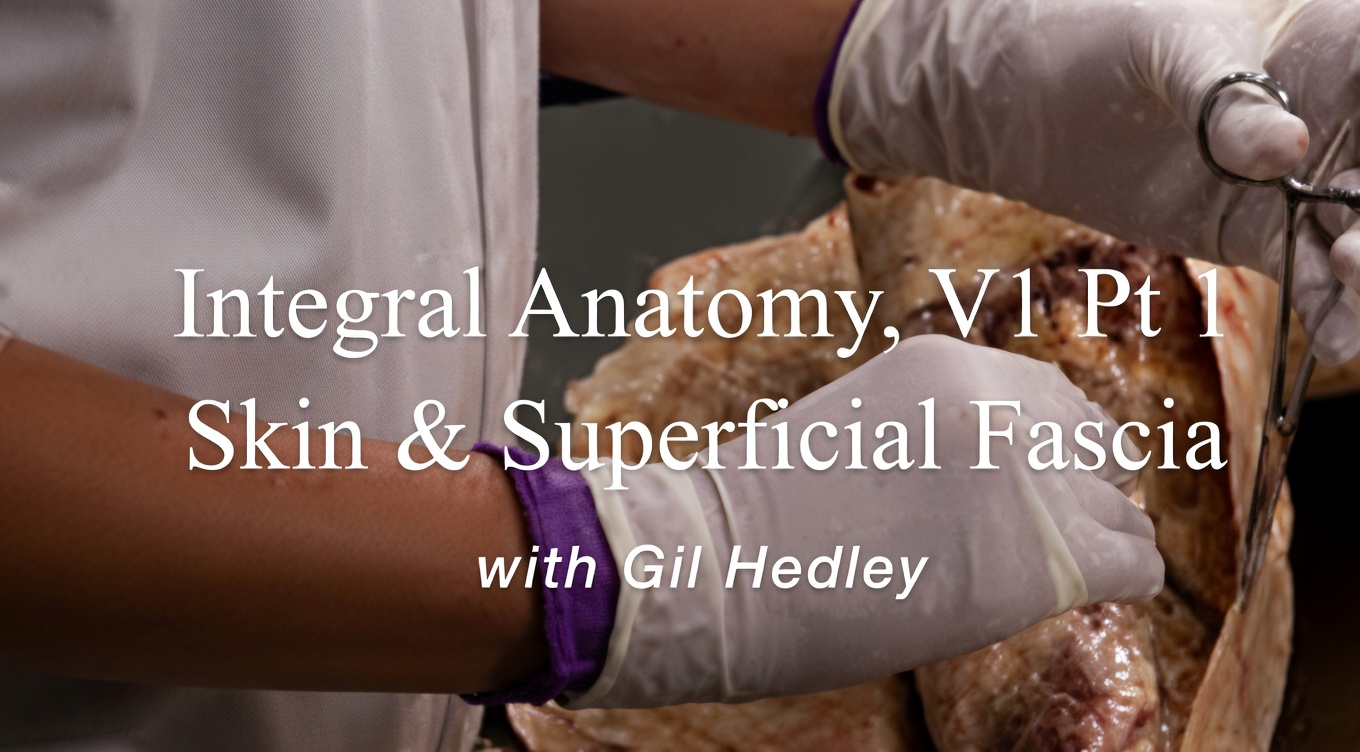
The work of Gill Hedley is central to how we understand the Fascial body. His integral anatomy dissection series, now over twenty years old, revealed the true connections within the body that conventional anatomical dissection cannot show, because conventional dissection removes Fascia before studying the structures beneath. Hedley preserves it. What you see when you do that completely changes your understanding of how the body is organised and why chronic pain develops the way it does.
This series is more than two decades old. We have been working at this level of understanding for that entire time. And in that same period, your GP has not been taught a single frame of it. That is not a criticism of them as individuals. It is the reality of an educational system that has not kept pace with what the research established long ago.
Part 1 of Gill Hedley's integral anatomy series. The full series goes much deeper into the Fascial connections that explain why chronic pain travels and persists the way it does.
When you understand Fascia this way, and when you understand how it is organised into the continuous chains that Tom Myers mapped, you stop seeing pain as a local problem. You start seeing it as a whole-system signal. And the question changes from "what is wrong here?" to "where in this connected system is the restriction that is pulling everything out of balance?" That is the question the Physology Method is built to answer.
The New Map of Your Muscular System
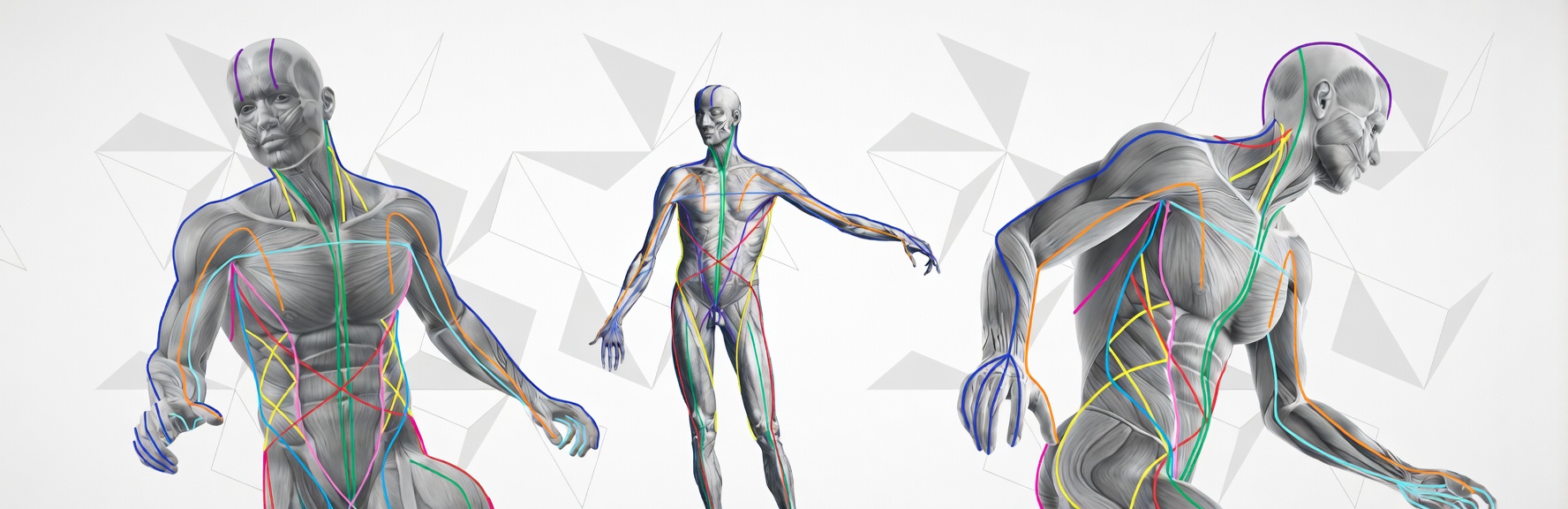
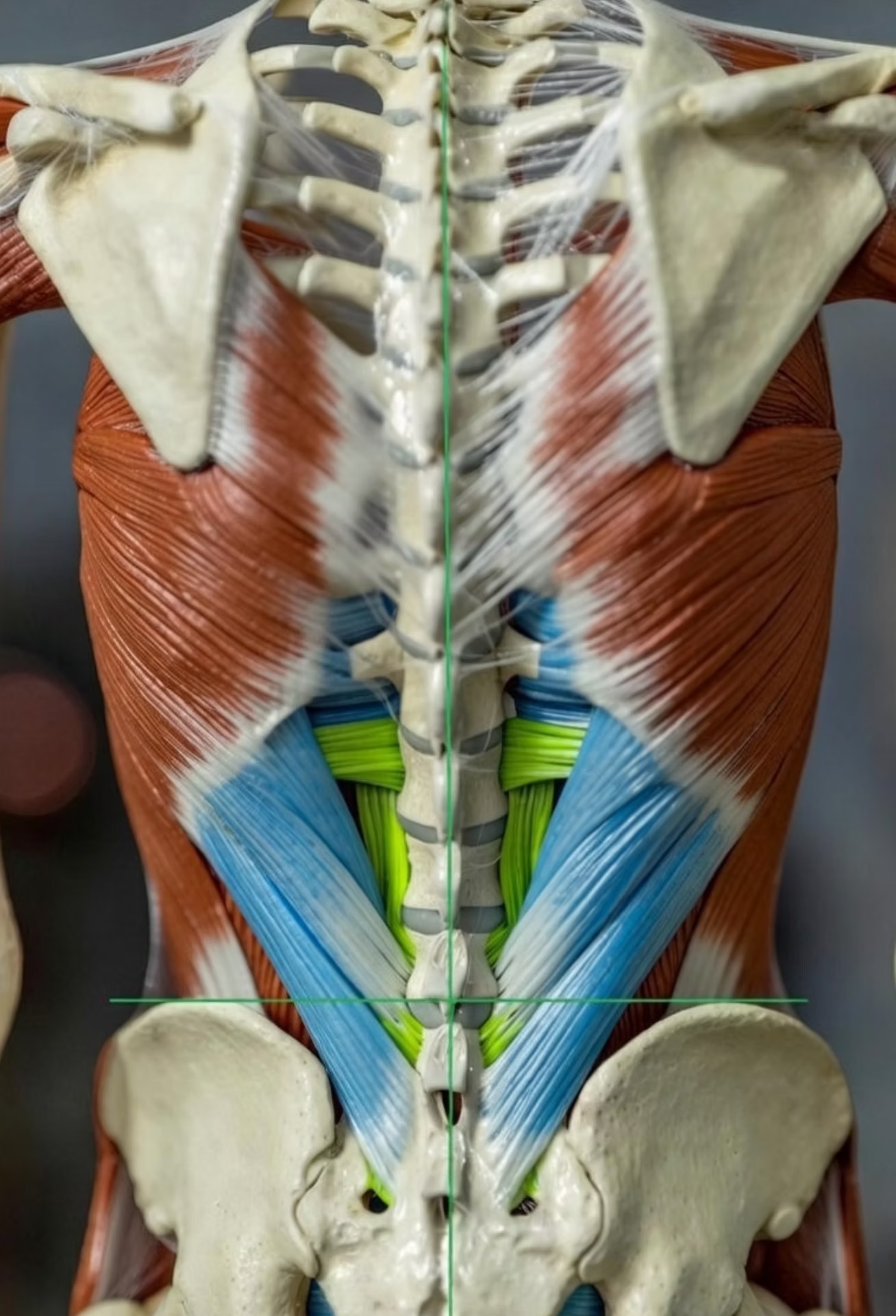
The red muscle charts you see in GP surgeries and physiotherapy clinics show muscles as isolated units. Each with its own origin, insertion, and action. That model is still being taught. It is also out of date. We know now, from dissection and from research, that muscles do not work in isolation. They are connected through Fascia into continuous lines that run the full length of the body. Tom Myers mapped those lines, and the result is a completely different picture of how the muscular system actually works.
The Anatomy Trains map. This is what your muscular system actually looks like when you account for the Fascial connections. The isolated red muscle charts in your doctor's surgery do not reflect this.
The moment you understand this map, you understand why no one has been able to explain your pain. If the practitioner treating you is working from the old model, they are looking at a fundamentally incomplete picture of how your body is structured and how tension travels through it. A restriction in your foot can pull on your lower back. A tight hip flexor can drive headaches. A compressed diaphragm can affect your neck. None of that makes sense on the old charts. All of it is obvious on this one.
The Body Is a Tensegrity Structure
Understanding the Anatomy Trains map leads directly to understanding tensegrity, the structural principle that explains why the whole body is affected by a restriction in any single part of it.
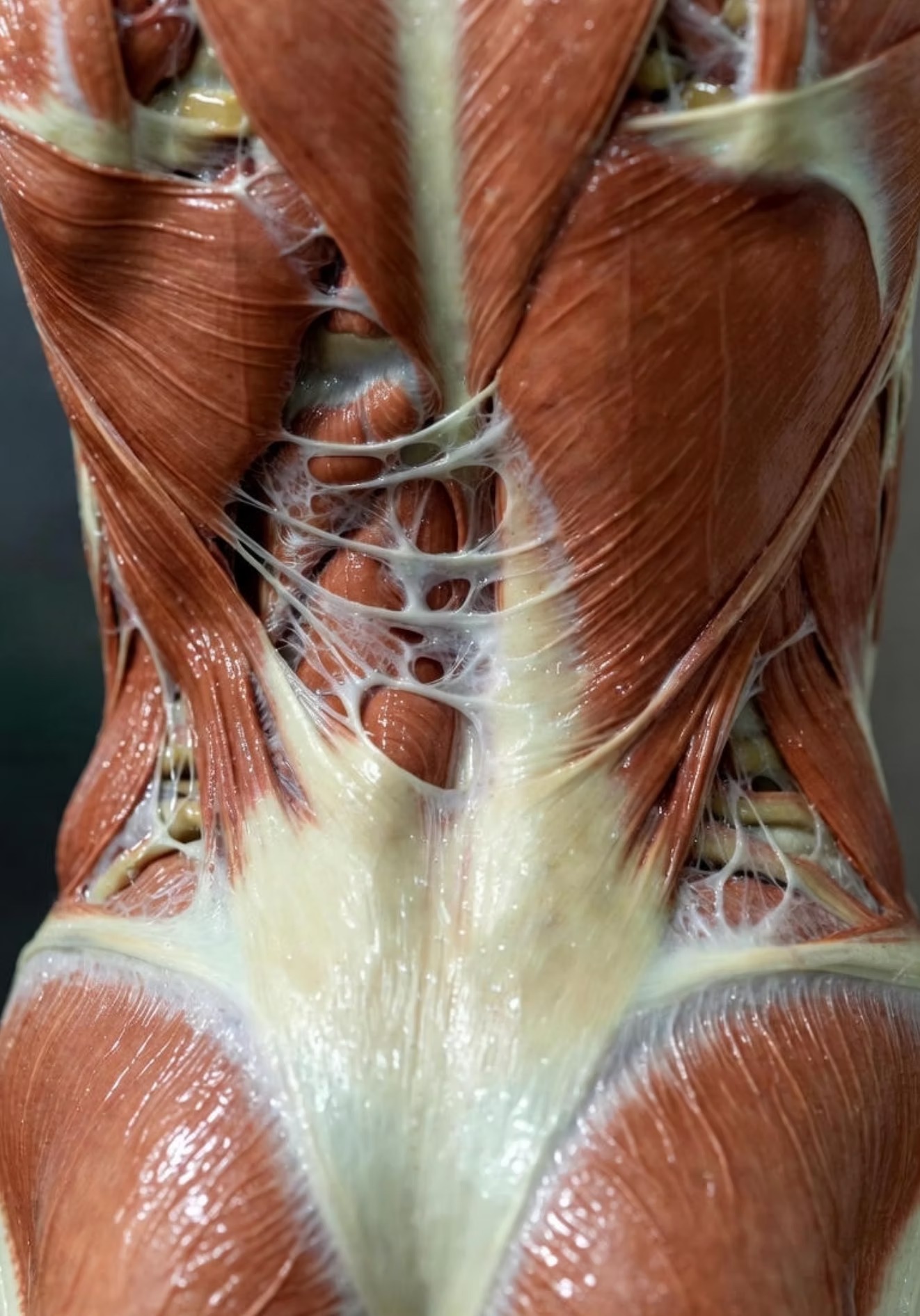
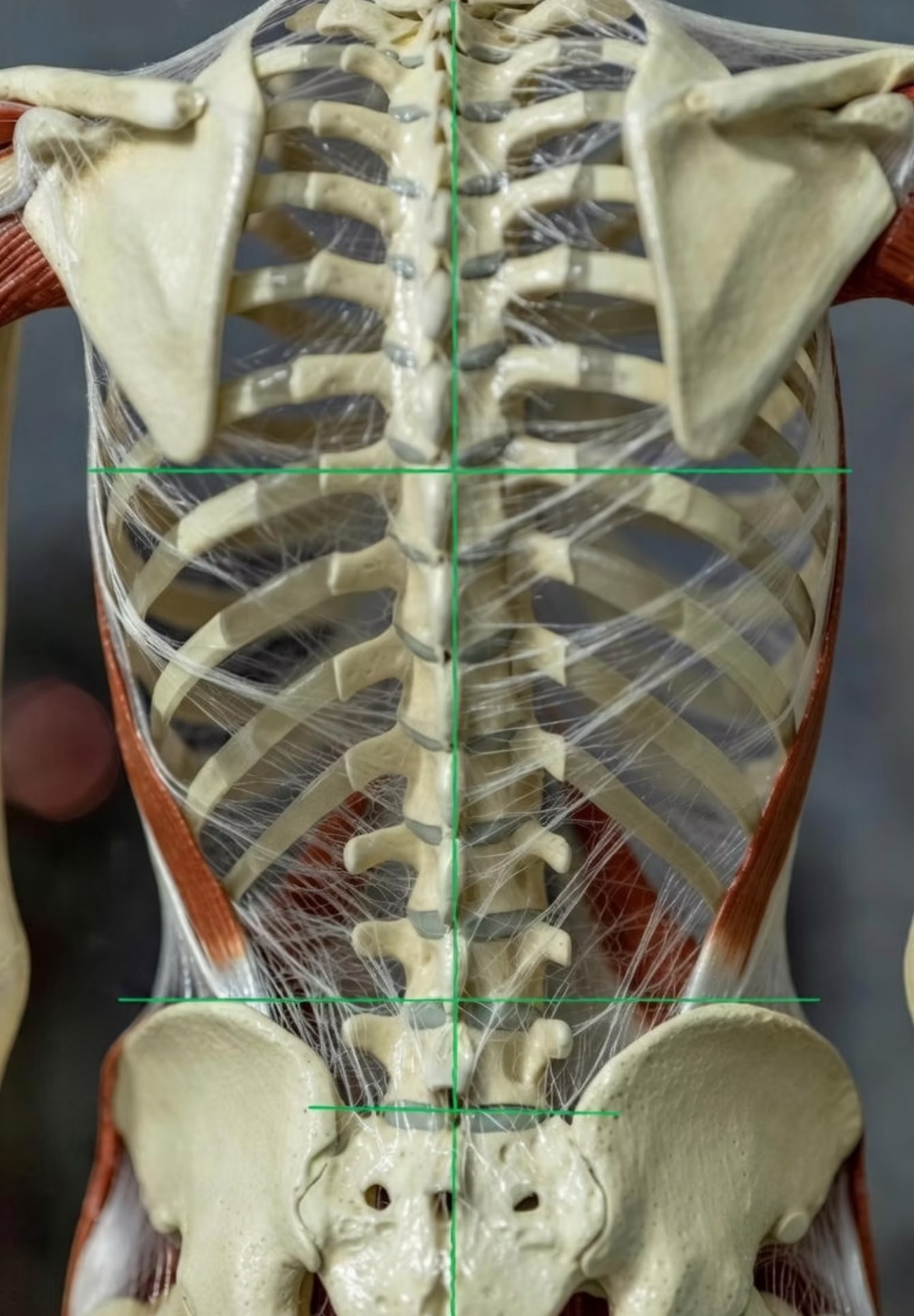
Traditional anatomy taught that the skeleton was a compression structure, bones stacked on bones like a column, held upright by muscles pulling against each other. That model is wrong. The body works as a tensegrity structure, a term borrowed from architecture that combines tension and integrity. In a tensegrity system, the rigid elements, your bones, do not rest on each other. They float within a continuous network of tension, your Fascial web, held in position not by compression but by balanced pull from all directions simultaneously.
Tom Myers demonstrates tensegrity with a physical model, showing exactly how force distributes through the Fascial system when any part of it is compressed or restricted.
When you push one element of a tensegrity structure, the force does not stay local. It distributes through the entire network. Every other element adjusts. That is precisely what happens in your body when a Fascial restriction develops. The local area tightens. The skeleton shifts slightly to accommodate it. Muscles on the opposite side overwork to compensate. Other areas of Fascia come under increased strain. And eventually, somewhere in the chain, the accumulated tension finds its weakest point. That is where the pain appears. Rarely at the original restriction. Always as a consequence of it.
This is why treating where it hurts almost never resolves chronic pain for good. You are treating the consequence, not the cause. The Physology Method is built to find the cause.
The R3 System: Release, Realign, Retrain
Once we have assessed the whole Fascial system and identified the primary restrictions and their downstream effects, treatment follows a clear three-phase process. This is the R3 System, and it is what gives the Physology Method its structure and its predictable outcomes.
R1
Phase One
Release
A comprehensive Anatomy Trains assessment identifies the primary Fascial restrictions, both at the site of pain and along the connected lines that are maintaining the problem. Precise, hands-on Fascial release work addresses these restrictions directly, restoring the tissue's capacity to glide freely, reducing the compressive load on the surrounding structures, and quieting the persistent pain signals the restricted tissue has been generating.
Most patients reach 80 to 100% pain-free during this phase. The timeline varies by individual, but most of the measurable change happens within the first two to four weeks of treatment.
R2
Phase Two
Realign
Releasing the primary restrictions changes the tension map of the whole Fascial system. The skeleton, which floats within that Fascial web, begins to return to its natural alignment. Muscles that have been overworking to compensate for years of restriction begin to function normally again. Others that have been inhibited, unable to activate properly within a restricted Fascial envelope, begin to come back online.
This phase consolidates the structural change that Release initiated, restoring the balanced tensegrity that allows the body to maintain good posture and even load distribution without effort. It is what prevents the pain from returning.
R3
Phase Three
Retrain
For patients who want to actively embed the new alignment and rebuild the movement patterns that the restrictions had compromised, we provide simple postural and movement exercises targeted to the specific changes made in their system. This is optional. Many patients find that the combination of Release and Realign produces lasting results without further intervention, and choose instead a single maintenance session every six months to maintain the structural balance the treatment has restored.
Twenty Years of Development, Five Years at the Highest Level
The Physology Method was not designed in a classroom. It was built through twenty years of clinical practice working with people in chronic pain, refining the assessment approach, developing the treatment techniques, and testing the outcomes. It emerged from working with Fascia long before Fascia became a recognisable term in mainstream wellness.
20+Years clinical experience
5Years with Everton FC first team
30–50%Typical first session improvement
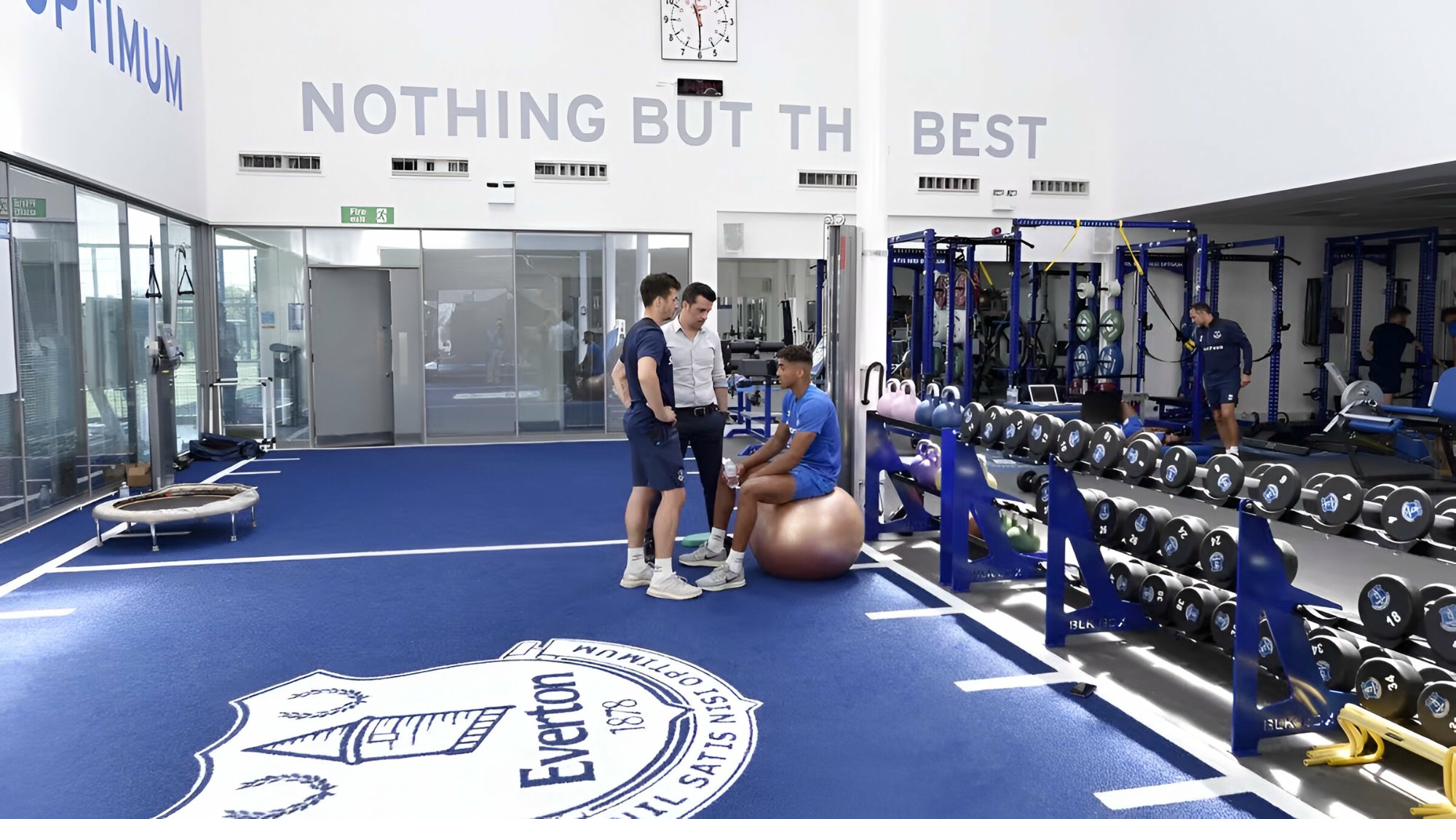
In 2013, we began working with Everton FC as part of their first team medical staff. For five years the Physology Method was applied at Premier League club level, keeping players available for selection by identifying and resolving the Fascial restrictions that conventional sports medicine was missing. Since then, professional football has changed. Many elite players now manage their own medical care directly, working with specialists outside club structures. We continue to work with Premier League players through those direct relationships today. The standard has never changed: find the real cause, resolve it, and prevent it from returning.
That credibility matters to us because it means the method has been tested under conditions where failure is immediately visible and consequences are measurable. But the people we are most committed to helping are not Premier League footballers. They are the people in Bath and Bristol who have been in chronic pain for months or years, who have been through the system, and who have been unable to get a clear explanation of what is wrong or a treatment that actually changes it. For them, the Physology Method represents the same quality of thinking and assessment that elite sport relies on, applied to the problems that conventional healthcare has been unable to resolve.
The Conditions We Treat in Bath and Bristol
The Physology Method is not condition-specific. It is a whole-body Fascial assessment and treatment approach that addresses the underlying system rather than the diagnostic label. That said, some of the conditions we see most consistently, and where the results are most predictably measurable, include the following.
01
Fibromyalgia
Widespread Fascial restriction across multiple Anatomy Trains lines, combined with the central sensitisation that persistent Fascial pain creates, produces the diffuse, whole-body pain that characterises fibromyalgia. The medical system finds it difficult to treat because it cannot see the Fascial component. We can assess and treat it directly. Patients with fibromyalgia often report more measurable improvement from Physology treatment than from any other approach they have tried.
02
Chronic Back Pain
Almost always a whole-system Fascial problem rather than a local structural one. The drivers are typically in the pelvis, the diaphragm, the posterior chain, or the deep hip flexors, none of which are usually assessed or treated in conventional back pain management. The Physology Method identifies the specific pattern of restriction driving each individual's back pain and addresses it at the source.
03
Long-term chronic pain
Pain that has been present for years, that has resisted multiple treatment approaches, and that has been attributed to various causes without resolution, is almost always a Fascial problem. The longer pain has been present, the more the system has compensated, and the more important a whole-body Fascial assessment becomes. These are often the patients who benefit most dramatically from the Physology Method, because it is frequently the first time the actual cause has been identified and treated.
What Patients Say
★★★★★
"I arrived at my first session in a lot of pain as my back had gone again. I walked out pain free and astounded. Not even a minute of pain on a 17-hour flight to Thailand two months later."
Charlotte Mather — 28 years of back pain
Pain free after 28 years
★★★★★
"I suffered with constant overuse injuries for two years before I hired James. Since I started working with him I have stayed injury free for over 3 years. In those three years I have broken 3 British records."
Tom Bosworth MBE — GB Olympic Race Walker, UK No.1
3 British records broken. Third fastest British man in history
★★★★★
"I left it mind blown. James taught me so much about my body that I didn't know. The first treatment helped my pain instantly and then I never looked back. Been pain free ever since."
Isabella Davies — Fibromyalgia, 4 years
Pain free. Got her life back
If what you have read describes your experience, a conversation costs nothing.
The first session at Physology is not a standard physiotherapy assessment. It is a comprehensive Fascial mapping process that takes your history fully, not just the current complaint but the whole story of your body, from your earliest injuries and postural patterns through to your current situation. Because Fascial restrictions accumulate over time and spread through the connected system, understanding the full history often reveals patterns that make complete sense of a pain presentation that has previously seemed mysterious or contradictory.
We then assess your whole Fascial system, working through the relevant Anatomy Trains lines to identify where the primary restrictions are and how they are relating to your symptoms. We explain everything as we go. By the end of the session, you will have a clear understanding of what is actually happening in your body, why it has been so difficult to resolve through conventional approaches, and what the treatment plan looks like.
Most patients also receive treatment in that first session and notice a measurable reduction in their pain before they leave, because for the first time the tissue generating the pain is being addressed directly.
Perspective
The Real Cost Is Everything You Have Already Spent
£10k+Typical specialist spend over 10 or more years
£2k+/yrOngoing medication and pain management costs
YearsLived in pain, doubt, and reduced quality of life
4 to 8Sessions to pain free with the Physology Method
Charlotte spent tens of thousands over 28 years before one session changed everything. The consultation is your chance to find out whether Fascia is the missing piece, with measurable proof on the day.
Common Questions
The Physology Method is designed for anyone with chronic pain that has not been resolved through conventional treatment. We see fibromyalgia, chronic back pain, sciatica, neck pain, shoulder pain, hip and knee pain, headaches and migraines, sports injuries, and post-surgical pain. If the Fascial system has not been assessed, the Physology Method is the assessment that finds what has been missed.
Physiotherapy assesses and treats the muscles and joints at the site of pain. It is skilled work that truly helps many presentations. What it does not assess is the Fascial system connecting those structures to the rest of the body. When chronic pain is driven by a Fascial restriction pattern that originated elsewhere in the system, local treatment cannot reach the source. The Physology Method is specifically designed to find and treat that source.
Get in touch, tell us your symptoms and history, and we will tell you whether we can help and what treatment is likely to involve. Every presentation is different and we prefer to give you a clear, specific answer rather than a generic price list.
Because the approach is results-based, you will not need to guess. The change in session one is clear and measurable, and each subsequent session produces further improvement you can feel. Most patients are between 4 and 8 sessions in total. You will always know the treatment is working because you will feel the difference each time.
The first session is two hours. We begin with your full history, listening to everything about your pain and previous treatment. We carry out a complete whole-body Fascial assessment using the Anatomy Trains framework, explaining everything as we go. Treatment begins in the first session, and most patients leave with a measurable reduction in pain and a clear understanding of what has been driving their symptoms.
Yes. We see patients from across Bath, Bristol, Frome, Wells, Chippenham, Trowbridge, Bradford on Avon, and the wider Somerset, Avon, and Wiltshire area. Physology is at WellBath Yoga and Wellbeing Centre, Woolley Lane, Bath BA1 8BA.
Message us on WhatsApp with a brief description of your symptoms and how long you have been dealing with them. James responds to every message personally, usually the same day. He will tell you whether your presentation fits the pattern we treat and exactly what the first session will involve before you commit to anything. There is no obligation and no pressure. Send a message here.
✓
The Physology Guarantee
If you do not feel a measurable reduction in pain in your first session, the consultation is free. No awkward conversations, no conditions. We are confident enough in what we do to put that in writing.
Physology Bath & Bristol
Ready for a Clear Plan?
A Physology consultation gives you a full Fascial assessment, a clear explanation of what is driving your pain, and a structured plan for becoming pain-free. Most patients leave with a measurable reduction in pain and a clear plan for the sessions ahead.
"I arrived at my first session in a lot of pain. I walked out pain free and astounded. Not even a minute of pain on a 17-hour flight to Thailand two months later. Whatever James has worked is miraculous."
Charlotte Mather — 28 years of back pain
Pain free after 28 years
P.S. If you have been through the system with chronic pain and you are sceptical that one more practitioner is going to make any difference, that scepticism is completely understandable. Every patient we have helped felt exactly the same way before their first session. The only thing that separates them from where you are now is that they got in touch.