The Real Reason It Hurts Everywhere. And Why Most Explanations Are Missing the Truth. An Evidence-Based Approach To Fibromyalgia With Research That Is Decades Ahead Of The Education System.
What Fascia Really Is: The Body's Hidden Web
Fibromyalgia pain feels like it's everywhere at once. Deep aches that never fully fade, burning sensations under the skin, sharp stabs that catch you off guard, and an exhaustion that makes even simple tasks overwhelming. You've probably spent years searching for answers, only to hear vague explanations like "central sensitisation" or "amplified nerve signals" that don't explain why it started or how to truly stop it.
At Physology, here in Bath and serving clients across Bristol too, we see your pain differently, and with absolute certainty.
With over 100 years of Fascia research from the best medical scientists in the world, we understand Fibromyalgia pain at a depth that isn't yet taught in the traditional healthcare system. Your GP or Physio hasn't been taught this. There is a gap between the research and the education.
After more than 20 years working exclusively with Fascia, we've seen the research prove time and again that Fibromyalgia's widespread, unrelenting symptoms stem from restricted Fascia, the body's continuous connective tissue web. When Fascia tightens and loses its natural glide, it creates mechanical tension that irritates nerves, pulls on muscles, and disrupts the entire system.
This Is the Most Important Video You Will Watch Regarding Your Fibromyalgia Pain
Your Symptoms, Explained With Certainty
1. Widespread Aching Pain
This is the hallmark of Fibromyalgia. A constant, dull, deep ache that spreads across large areas of the body, often feeling like you've run a marathon without moving. With 20+ years of Fascia expertise at Physology, we know this ache comes from dehydrated, restricted Fascia creating ongoing mechanical tension throughout the interconnected web. It's not "mysterious." It's the Fascia pulling and compressing tissues everywhere, explaining why the pain feels so unrelenting.
Many clients describe a hot, burning or stinging feeling on the skin or deeper in muscles, like sunburn from the inside. This isn't random nerve misfiring. It's restricted Fascia irritating and compressing sensory nerves along Fascial lines. When Fascia loses its natural glide and becomes adhesive, it traps nerves, creating that fiery sensation. We've seen this resolve dramatically with targeted release, proving Fascia is the true driver.
That frustrating "Fibro fog", trouble concentrating, memory lapses, mental sluggishness, isn't just stress. At Physology, we see it as chronic fight-or-flight, locked in a loop via Fascial restrictions, especially in the neck and cranium. Tight Fascia keeps the nervous system in survival mode, flooding the brain with stress hormones that impair thinking. Releasing these restrictions calms the response, restoring sharp mental clarity. Clients often say they've got their brain back.
Fibromyalgia's persistent brain fog often stems from low-grade metabolic acidosis triggered by Fascial restrictions. Tight Fascia impairs blood flow and lymphatic drainage, trapping metabolic waste in tissues and lowering pH. This systemic acidosis crosses the blood-brain barrier, disrupting neurotransmitter balance and causing inflammation that fogs cognition.
Sudden jolts happen when movement, or even posture shifts, tugs on adhesive knots in the Fascia, sending sharp signals along the entire connected web. One restriction in the lower back can extend into the neck because Fascia lines link distant areas. This referred pain is classic in Myofascial patterns, and studies show how Fascial densification sustains it.
Tight Fascia lowers the pain threshold by constantly compressing nerves, turning light touch, clothing friction, or temperature changes into agony. The Fascia's rich nerve supply means restrictions amplify every input, explaining why hugs or bedsheets feel painful.
Chronic Fascial tension locks the body in low-grade fight-or-flight. The sympathetic nervous system stays on alert, preventing deep recovery. Restricted Fascia around the torso and neck disrupts blood flow and tissue repair, leaving you exhausted even after sleep. This sympathetic overdrive is well-documented in Fibromyalgia pathology.
Poor sleep and digestive troubles like IBS are common in Fibromyalgia, but they're not separate issues. Restricted Fascia, especially around the torso, neck, and pelvis, keeps the body in chronic fight-or-flight mode, disrupting the autonomic nervous system. This constant stress state prevents deep restorative sleep and impairs gut motility, causing bloating, constipation, or diarrhoea. As we release Fascial restrictions, the nervous system calms, and natural sleep cycles and healthy digestion return.
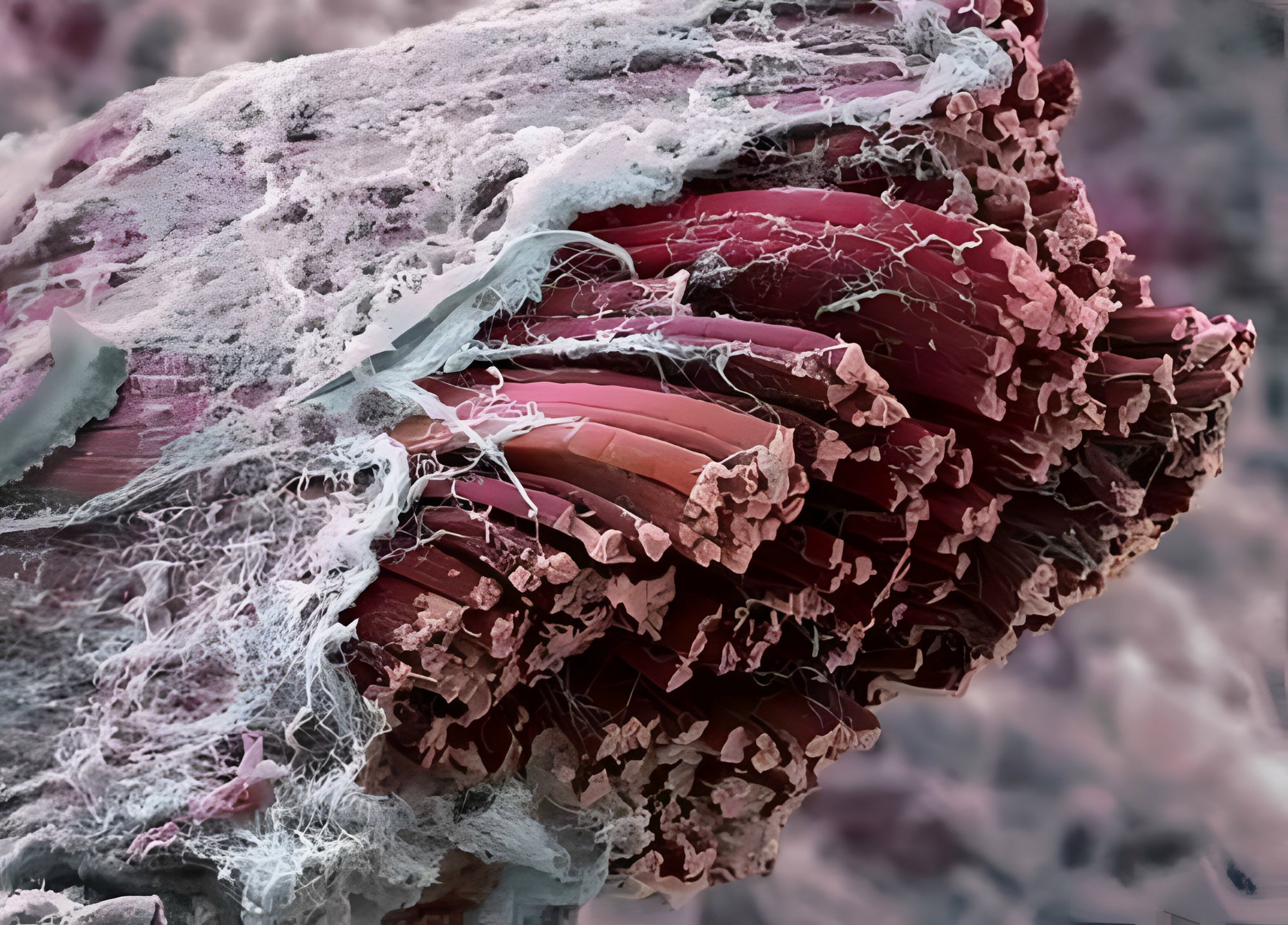
Seen here as the white web structure surrounding the muscle fibres, Fascia surrounds every strand of every muscle, every nerve, every blood vessel, every organ and every other cell in the body. It is one single continuous web full of pain receptors. You feel pain in your Fascia.
What This Means For Your Treatment
For over 20 years at Physology, we've specialised in a Fascia-focused approach to Fibromyalgia. Clients with decades of Fibromyalgia pain often experience 30% to 50% reduction in the first session, because we are addressing the actual mechanical cause, not managing symptoms.
Tom Myers spent decades mapping the body's Fascial lines in his landmark work Anatomy Trains, showing that Fascia doesn't just wrap individual muscles in isolation. It runs in continuous lines from foot to skull, connecting structures that conventional anatomy treated as separate.
A restriction in one part of a line creates tension, compensation, and pain along the entire connected path. This is why Fibromyalgia pain appears in multiple areas at once, why it moves, and why treating one site in isolation has never resolved it.
Add to this the research on Fascial hydration and dehydration, which shows that Fascia changes its mechanical properties dramatically based on its water content, and the picture becomes clear. Dehydrated, restricted Fascia compresses nerves and generates pain signals continuously. Restore its hydration and glide through targeted manual release and those signals reduce, often immediately.
These two bodies of research together, Myers' mapping of the Fascial lines and the hydration science, form the foundation of the Physology Method, and they explain why our clients experience measurable pain reduction from the very first session.
On the next page, you will understand why your GP and Physio have never been able to find this, and why that isn't their fault.
Next: Why Traditional Treatments Fall Short (3 of 5)
Continue with your Fibromyalgia focused education by clicking onto the next page in the series below.