What Is Fascia? The Hidden Network Behind Chronic Pain
The system that connects every structure in your body, shapes how force travels through it, and explains the pain that scans consistently miss.
The Body's Forgotten Network
Fascia has been studied for over a hundred years. The anatomists who first described it understood it as connective tissue. What they could not have known was how central it would prove to be in understanding chronic pain.
The real shift came in the last two decades. The first international Fascia Research Congress at Harvard Medical School in 2007 brought together researchers who had been working in isolation and produced a body of evidence that changed the field entirely. Since then, the pace of discovery has been extraordinary. We now know that Fascia is not passive tissue. It is a body-wide sensory organ, densely packed with pain receptors and proprioceptors, capable of generating pain signals independently of any muscle or joint damage. We know it thickens and restricts in ways that are measurable and treatable. We know it transmits force and tension across the entire body, not just locally. And we know that its role in chronic pain is primary, not secondary.
Elite sport absorbed this quickly because the consequences of getting it wrong are immediate and public. We have been working at Premier League level since 2013, beginning with Everton FC's first team medical staff and continuing today through direct work with players who now manage their own medical care independently. Professional football has changed and many elite players no longer rely solely on club medical teams. We work directly with those players. Your GP and physiotherapist were not taught this. That is not a failing of theirs. It is the ordinary, frustrating gap between what research has established and what the educational system has caught up with.
What the video below shows is what that understanding looks like when you remove the skin and see what was always there.
So What Exactly Is Fascia?
Fascia and the Mystery of Chronic Pain, by Dana Sterling
Fascia is a continuous, three-dimensional web of connective tissue that runs through every part of your body without a single interruption. It surrounds and threads through every muscle, every organ, every nerve, every blood vessel. It wraps your bones. It holds your organs in place. It gives your skin its ability to stretch and slide.
For decades it was treated by anatomists as packing material, something to cut through to get to the interesting structures underneath. The old red muscle charts you still see on the walls of GP surgeries and physiotherapy clinics show muscles as separate, isolated units, each with its own origin and insertion. That model is now known to be incomplete. Fascia makes the body a single, continuous, interconnected system, and when you understand that, everything changes about how you understand pain.
Think of Fascia as a body-suit worn underneath your skin and woven through every layer beneath it. Not a passive wrapping, but a living, responsive, sensation-rich system that is constantly adapting to how you move, how you hold yourself, and what stresses your body has accumulated over time.
The Three Layers of Fascia
1
Superficial Fascia
The layer just beneath the skin. It stores fat, allows the skin to slide over deeper structures, and contains a rich network of blood vessels and lymphatic channels. Restrictions here affect fluid movement and can contribute to areas of localised tenderness and swelling.
2
Deep Fascia
The dense, tough layer that surrounds and penetrates the muscles themselves, wrapping individual muscle fibres, bundles of fibres, and whole muscles in a continuous sheath. This is the layer most directly involved in chronic pain. When it thickens, dehydrates, or becomes restricted, it compresses the structures it surrounds and pulls the body out of alignment.
3
Visceral Fascia
The layer that suspends and separates your internal organs. Restrictions in visceral Fascia can affect organ function, breathing mechanics, and even postural balance, contributing to pain patterns that have no obvious muscular explanation.
A Closer Look at How Your Fascia Really Looks
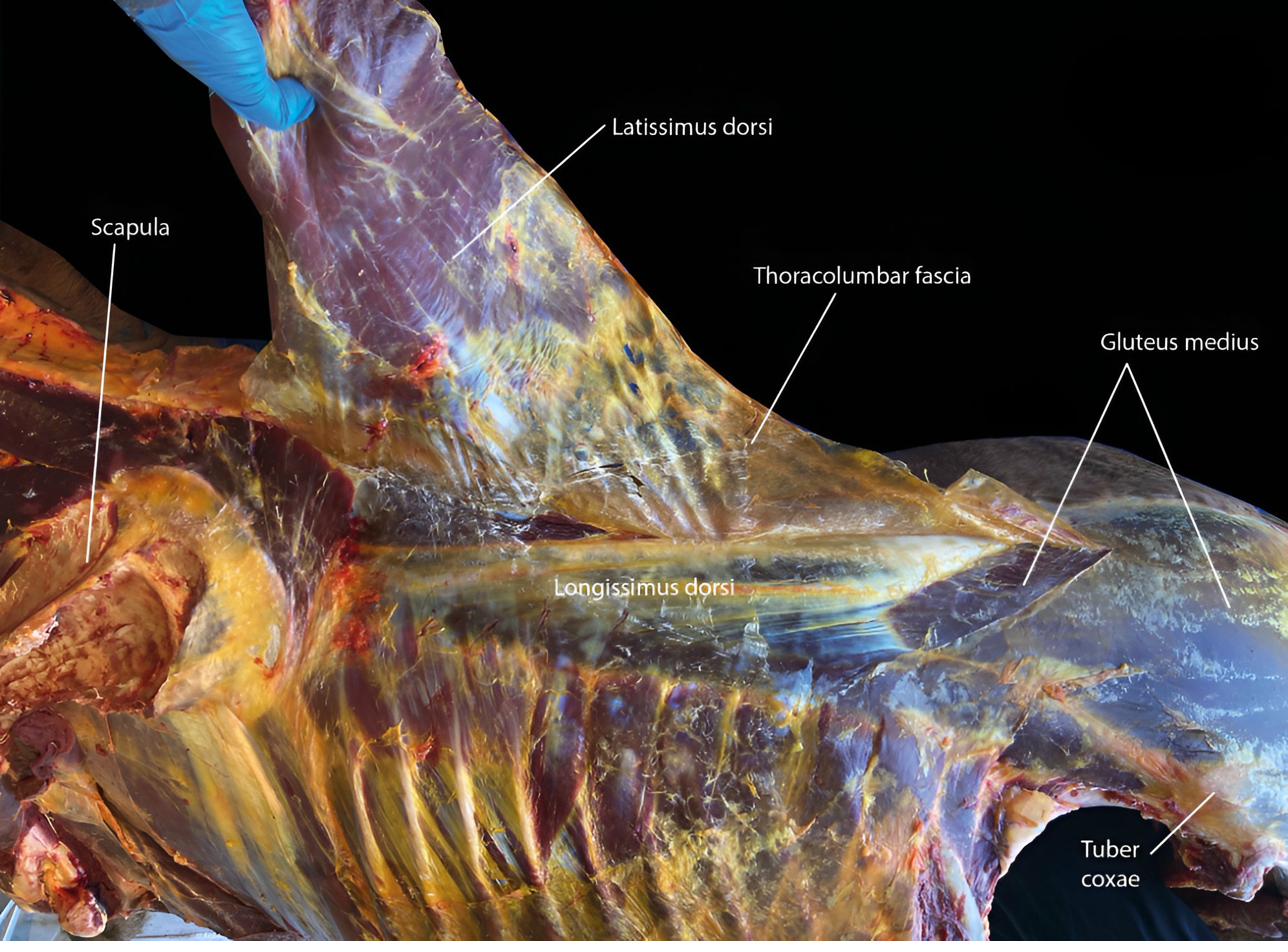
Most people have never seen what Fascia actually looks like inside the body. When it is healthy it is almost transparent, fine-webbed, and completely fluid in the way it glides between structures. When it becomes restricted, it thickens, compresses, and starts to pull on everything around it. This short dissection clip from Anatomy Trains shows you exactly what we are working with when we treat Fascial restriction. What you are looking at is the tissue that has been generating your pain.
Anatomy Trains dissection series, showing Fascial tissue at the site of restriction
This is what a scan cannot show you. The change in the tissue is visible and measurable, but it requires a different kind of assessment to find it. That assessment is what we do at Physology.
The Four Ways Fascia Creates Pain
Once Fascia becomes restricted, it sets off a cascade of effects that explains many of the most common chronic pain presentations. Understanding these mechanisms is the first step to understanding exactly where your pain is coming from.
Densification
The Fascial layers thicken and lose their capacity to glide freely against each other. Movement becomes restricted, and the forces that should distribute evenly through the whole system instead concentrate at specific points, creating chronic loading and pain.
Inflammation
Restricted Fascia releases inflammatory cytokines that directly sensitise the surrounding pain receptors. This is a measurable physiological process. The tissue is in a state of low-grade, chronic inflammation that conventional imaging cannot detect.
Nerve compression
As Fascia thickens around muscles and nerves, it can compress neural tissue directly, creating the burning, tingling, and shooting sensations that are often attributed to disc problems or nerve root involvement, when the driver is actually the Fascial envelope around the nerve.
Central sensitisation
Persistent Fascial pain signals eventually change how the brain processes pain. The threshold drops. The nervous system becomes amplified. This is the mechanism behind conditions like fibromyalgia, where pain becomes widespread and disproportionate to any local tissue finding.
Why Fascia Has Been Overlooked
There are two reasons, and neither reflects badly on the individual practitioners who have been unable to help you.
The first is structural. Traditional anatomy was built on dissection, and dissection requires cutting. When anatomists removed Fascia to expose the muscles beneath, they discarded the very tissue that connected everything. The resulting maps showed muscles as isolated structures because the connecting web had already been removed before the mapping began.
The second is educational. Even as the research emerged, particularly from the 2007 Harvard Fascia Research Congress onwards, the knowledge grew fastest in specialist circles and elite sport, with the broader educational system taking longer to integrate it. The good news is that the research is now well-established, and practitioners working from it consistently produce outcomes that the older models cannot match.
If you have been living with chronic pain that has resisted conventional treatment, the most likely reason is that the Fascial system driving it has not yet been assessed.
Fascia does not show up on MRI scans, X-rays, or ultrasound in the way that disc problems and bony changes do. A normal scan result means the imaging technology being used was not designed to assess the Fascial system. That is a limitation of the tool, not a verdict on your experience.
The good news is that Fascial restriction responds well to skilled treatment. When pressure is applied to restricted tissue with the right technique and the right understanding of how the whole system connects, the tissue releases. Hydration returns. Movement improves. The pain signals that have been firing persistently begin to quiet. Most patients leave their first treatment at Physology with a measurable and immediate reduction in their pain, because for the first time, someone is working on what is actually causing it.
The next step is understanding how Fascia is organised across the whole body, because a restriction in one area does not stay local. It travels, it compensates, it creates symptoms far from where it originated. That is what Anatomy Trains explains, and it is the foundation of how we assess every patient at Physology.
Physology Bath & Bristol
Ready to Understand Your Pain?
A Physology consultation gives you clarity on what is actually driving your symptoms and a clear plan for becoming pain-free. Most patients experience a measurable reduction in pain from the very first session.
If you would like to go deeper before booking, our Fibromyalgia Focus Guide and our Chronic Back Pain Guide are full educational resources built around exactly this understanding of Fascia and chronic pain. They are free and written for people who want to actually understand what is happening in their body, not just be told what to do about it.
To understand how we map Fascial restriction across the whole body and trace pain back to its true origin, read about Anatomy Trains. And to understand the specific system we use to take people from chronic pain to pain-free, read about The Physology Method.