Back Massage Bath: When the Back Is Not the Problem
Most back massage treats where you feel it. The Physology approach traces back pain to where it starts, which is almost never in the back itself. For patients in Bath and Bristol, that difference changes everything about what treatment can achieve.
20+Years Clinical Experience
5 YrsEverton FC Medical Team
30-50%Pain Reduction Session One
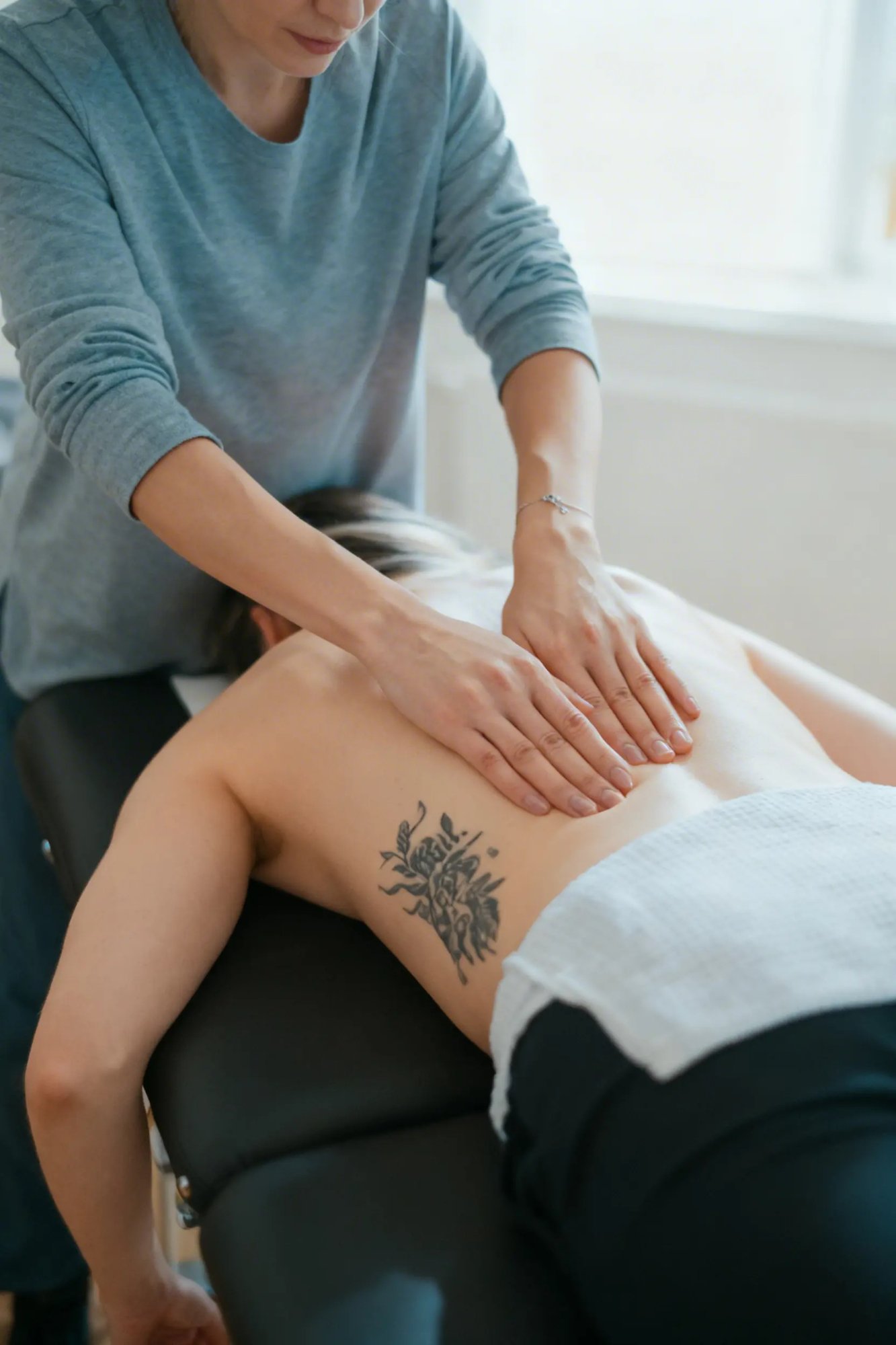
You booked a back massage. You want hands on the parts of you that are tight, sore, and tired of carrying the day. That is exactly what a Physology session gives you. What it also gives you, which most back massage in Bath does not, is time spent on the areas actually feeding that tightness before we ever touch the back itself.
Here is what that means in practice. Ask most people where a back massage should focus and they point to the same spot, low and to one side, the place that always seems to need working. Press on it and it eases. Stand up an hour later and it has already started to rebuild. That is not a sign the massage was too gentle. It is a sign the muscle doing the complaining is not the muscle doing the causing. Something upstream, the pelvis, the Diaphragm, the back of the thigh, is pulling that spot tight again as soon as you move.
At Physology, based at WellBath Yoga and Wellbeing Centre on Woolley Lane in Bath, we spend the first part of your session on that whole-body picture before hands ever reach the back. Then the back massage itself goes further, because the tissue underneath is no longer being re-tightened by something outside the room we are working in. We serve patients from across Bath, Bristol, Keynsham, Peasedown St John, Paulton, Shepton Mallet, and the wider region who want a back massage that still feels different a week later, not just an hour later.
The Muscle You Feel Is Rarely the Muscle Doing the Work
Every muscle in the back sits inside a sheet of connective tissue called Fascia, and that sheet is not local to the back. Years of breathing that never quite reaches down into the pelvis, sitting, driving, a desk, let the whole skeleton settle slightly out of its natural balance. The back is usually the part left carrying that imbalance, working harder than it was built to, long before it ever announces itself as pain.
Helene Langevin at Harvard Medical School measured what that looks like in the tissue directly: in people with chronic low back pain, the thoracolumbar Fascia is thicker and slides less between its layers than in pain-free backs. This is the part of the picture a back massage alone cannot reach, and it is exactly what we walk through properly in your consultation.
Every patient who comes to Physology with back pain receives a full Anatomy Trains assessment before any hands-on work begins. We use this to map exactly how the Fascial system is sustaining the back in its current state of restriction and compensation. We identify where the primary drivers are: the pelvis, the diaphragm, the posterior chain, the psoas, or a combination. We trace the compensation chain from its origin to the back, where you feel it. If the pain has persisted for years and kept returning despite regular treatment, our chronic back pain page sets out why massage on its own rarely resolves that cycle and what a full assessment adds.
The treatment then addresses the primary restriction directly, using deep Fascial release and back massage techniques together, working through the connected lines in sequence. The back is treated as part of the whole-system picture rather than in isolation. Patients typically notice a 30 to 50 percent reduction in back pain in the first session. Most reach full resolution within four to eight sessions with consistent improvement throughout.
If your back massage has always felt good on the day and forgotten by Thursday, nothing was wrong with the massage. The tightness had a source outside the room, and it followed you home.
Conventional Back Massage vs the Physology Approach
Conventional approach
The Physology approach
Works on the back muscles
Works on the Fascial chain driving tension into the back
Treats where the pain is
Finds where the pain originates, which is rarely in the back itself
Relief lasts hours or days before tension rebuilds
Lasting reduction when the Fascial source is directly released
No assessment of connected structures
Full assessment of pelvis, diaphragm, posterior chain, and hip flexors
No understanding of why pain keeps returning
Clear explanation of the restriction chain and how to resolve it
Session-by-session management
Structured resolution over 4 to 8 sessions with clear progress each time
A Closer Look at How Your Back Pain Really Looks
This dissection clip shows what restricted Fascia looks like at the site of pain. For anyone whose back pain has been described as muscular, structural, or unexplained, this is the tissue that conventional back massage and physiotherapy typically do not assess. When the restriction is addressed directly, the change in how the back feels is immediate and measurable.
Anatomy Trains dissection series, showing Fascial tissue at the site of restriction
The thoracolumbar Fascia is one of the primary Fascial structures involved in most back pain presentations. When you understand what it looks like in a restricted state and what happens to the structures compressed within it, it becomes clear why treating the muscles alone produces only temporary relief.
What Types of Back Pain Respond to Fascial Treatment?
Our Fascial back massage approach in Bath addresses the full spectrum of back pain presentations. Lower back pain is the most common, and it is also the presentation where the Fascial drivers are most consistently found away from the symptomatic site, in the pelvis, the hamstring chain, or the diaphragm. Mid-back and thoracic pain, which often presents as a deep, persistent ache between the shoulder blades or across the thoracic spine, almost always involves thoracolumbar Fascial restriction combined with anterior chain shortening. Upper back and neck pain that originates in the back responds particularly well when the Lateral Line and Superficial Back Line are assessed as a whole rather than treated segment by segment.
We also see patients with sciatica, sacroiliac joint pain, and the post-surgical back pain that has persisted despite technically successful procedures. In each of these presentations, the Fascial assessment reveals compensation chains that have been maintaining the pain long after the original structural problem was addressed.
Back Massage in Bath and Bristol
Physology is located at WellBath Yoga and Wellbeing Centre, Woolley Lane, Bath BA1 8BA. We see patients seeking back massage from across Bath, Bristol, Midsomer Norton, Radstock, Frome, Wells, Glastonbury, Shepton Mallet, Trowbridge, and the wider Somerset, Avon, and Wiltshire area. For anyone who has searched for back massage Bath, back pain treatment Bath, or lower back pain specialist Bath and is specifically looking for an approach that addresses the root cause rather than managing symptoms, our Fascial assessment process is designed to find what has been missed.
Initial consultations are two hours. Follow-up sessions are typically sixty to ninety minutes. We work with a focused patient list rather than a high-volume model, ensuring each session delivers the depth of assessment and treatment the individual situation requires.
What Patients Say
★★★★★
"After close to a year of various healthcare professionals assessing and treating my back injury gained from playing football, I chanced on James through a friend's referral just before I was to be sent for surgery through the NHS. I went from hardly being able to walk to playing football again within about 2 months, rather than having to go under the knife."
Chris Quinlan — Back injury from football, facing NHS surgery
Playing football again within 2 months, surgery avoided
★★★★★
"I had suffered with lower back pain and sciatic pain for 25 years, but it had become particularly severe in the last 3 years. I had been to physiotherapy and also an osteopath, but sadly the pain always returned. A few sessions on and I am able to get on with the usual jobs in life, with no pain and so much more flexibility."
Bu Bee — 25 years of lower back and sciatic pain
Pain free with full flexibility restored
★★★★★
"I had debilitating back spasms and pain that meant I could barely walk. After one treatment session with James I was moving better than I had before. I have continued with treatment and can now run, do an hour of aerobics and walk wherever I want to."
Auli Miles — Debilitating back spasms, facing back surgery
Running, exercising, and walking freely again
If what you have read describes your experience, a conversation costs nothing.
Your first appointment at Physology runs two hours, and most of that time happens before you are on the table. Back massage on its own rarely resolves back pain for good, because the muscles doing the aching are often compensating for a Fascial restriction somewhere else entirely. We spend the first part of your session finding that somewhere else, using your history and a full Anatomy Trains assessment, so the hands-on work that follows goes to the actual source rather than the familiar spot.
1
Telling Us Where It Started
We ask about every flare-up, every previous massage or manipulation that helped for a week and then stopped helping, and every activity that sets your back off. Back pain histories are rarely random once you look at them properly. They usually show the exact route the Fascial restriction has travelled to reach where you feel it.
2
Mapping the Whole Back Line
Using the Anatomy Trains framework, we assess posture and movement well beyond the sore patch: the pelvis, the Diaphragm, the Superficial Back Line, the deep hip flexors. Back massage that never looks past the shoulders or the lower back is working on one link of a much longer chain.
3
Why the Old Massages Wore Off
Once the assessment is complete you will understand exactly why previous massage gave relief that faded within days. Muscle work released tension in the tissue in front of you; it never reached the restriction pulling on it from elsewhere. Most patients find this the first moment their back pain has actually made sense.
4
Hands-On Treatment, First Session
We treat straight away, combining back massage with Fascial release work targeted at the restriction the assessment has found, not just the area that hurts. Most patients feel a 30 to 50 percent reduction in that first session, and full resolution typically takes four to eight sessions of measurable, cumulative change.
5
A Plan, Not Just an Appointment
You leave with a written understanding of what has been driving your back pain, a sequence of sessions built around it, and a realistic sense of how many you are likely to need, rather than another course of massage booked on a loop with no end point in sight.
Common Questions
Back massage reduces muscle tension and improves circulation in the back. If the driver of your back pain is Fascial restriction in the posterior chain, the diaphragm, or the deep hip flexors, working on the back muscles addresses the consequence rather than the cause. The relief is real but temporary because the restriction generating the tension has not been treated.
We begin with a whole-body Fascial assessment using the Anatomy Trains framework before any hands-on work. We identify where in the connected system the primary restriction is sitting, map how it connects to your back pain, and then apply treatment directly to the source as well as the back itself. This is what produces the lasting change that back massage alone cannot achieve.
Get in touch, tell us your symptoms and history, and we will tell you whether we can help and what treatment is likely to involve. Every presentation is different and we prefer to give you a clear, specific answer rather than a generic price list.
Because the approach is results-based, you will not need to guess. The change in session one is clear and measurable, and each subsequent session produces further improvement you can feel. Most patients are between 4 and 8 sessions in total. You will always know the treatment is working because you will feel the difference each time.
The first session is two hours. We begin with your full history, listening to everything about your pain, your previous treatment, and how it affects your life. We then carry out a complete whole-body Fascial assessment using the Anatomy Trains framework, explaining everything we find as we go. Treatment begins in the first session, and most patients leave with a measurable reduction in pain and a clear understanding of what has been driving their symptoms.
Physiotherapy assesses and treats the muscles and joints at the site of pain. It is skilled work and truly helps many presentations. What it does not assess is the Fascial system connecting those muscles and joints to the rest of the body. When chronic pain is driven by a Fascial restriction chain that originated elsewhere in the system, local physiotherapy cannot reach the source. That is the gap Physology is designed to close.
Message us on WhatsApp with a brief description of your symptoms and how long you have been dealing with them. James responds to every message personally, usually the same day. He will tell you whether your presentation matches what we treat and exactly what the first session will involve before you commit to anything. There is no obligation and no pressure. Send a message here.
Perspective
The Real Cost Is Everything You Have Already Spent
£10k+Typical specialist spend over 10 or more years of chronic pain
£2k+/yrOngoing medication and pain management costs
YearsLived in pain, doubt, and reduced quality of life
4 to 8Sessions to pain free with the Physology Method
Charlotte spent tens of thousands over 28 years before one session changed everything. The consultation is your chance to find out whether Fascia is the missing piece, with measurable proof on the day.
✓
The Physology Guarantee
If you do not feel a measurable reduction in pain in your first session, the consultation is free. No awkward conversations, no conditions. We are confident enough in what we do to put that in writing.
Physology Bath & Bristol
Ready to Find Where Your Back Pain Really Starts?
A Physology back massage consultation in Bath gives you a Fascial assessment, a clear map of what is driving your back pain, and measurable improvement from the first session. Serving Bath, Bristol, and the surrounding area.
"After close to a year of various healthcare professionals assessing and treating my back injury gained from playing football, I chanced on James through a friend's referral just before I was to be sent for surgery through the NHS. I went from hardly being able to walk to playing football again within about 2 months, rather than having to go under the knife."
Chris Quinlan — Back injury from football, facing NHS surgery
Playing football again within 2 months, surgery avoided
P.S. If back massage gives you relief that does not last, the source of the tension is outside the back. Get in touch and describe how your back pain behaves, what makes it worse, and what has helped temporarily. That history tells us where in the system the origin is most likely sitting.