The Best Treatment for Back Pain in Bath: Addressing the Cause, Not the Symptom
If you are looking for the best back pain treatment in Bath, the most important question is not which technique to choose. It is whether the practitioner you see is looking in the right place.
20+Years Clinical Experience
5 YrsEverton FC Medical Team
30-50%Pain Reduction Session One
Most people searching for the best treatment for back pain in Bath have already tried several approaches. Physiotherapy, chiropractic, osteopathy, massage, acupuncture, perhaps surgery. Some have helped. None has resolved it fully. The pain keeps coming back, sometimes in exactly the same place, sometimes shifting or spreading. The frustration is not just the pain itself. It is the feeling that despite all the effort and expense, something fundamental has never been found.
There is usually a reason for that. The most effective treatment for chronic back pain is not a particular technique. It is finding the correct assessment framework. And the assessment framework that conventional back pain treatment overwhelmingly uses is incomplete: it treats the back as the source of back pain. In the vast majority of chronic cases, it is not. The back is where pain is experienced. The source is almost always somewhere else in the Fascial system, driving restriction and compensation that accumulates in the back.
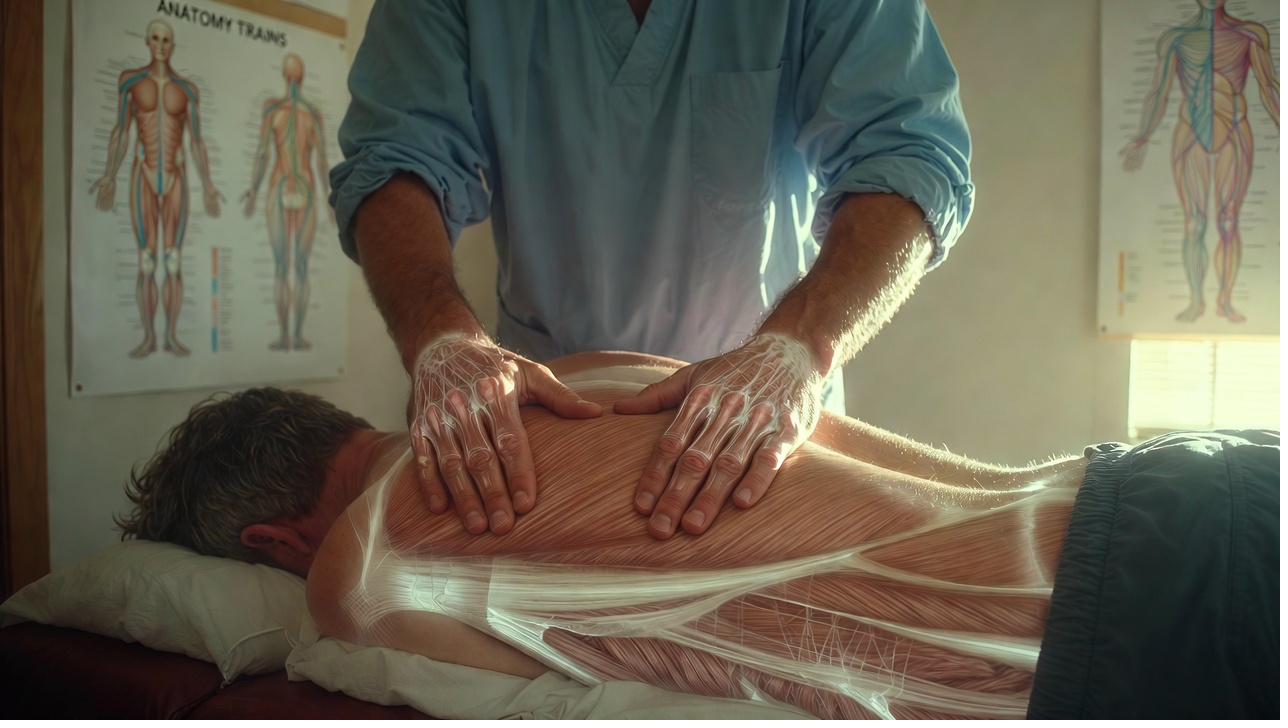
At Physology, based at WellBath Yoga and Wellbeing Centre on Woolley Lane in Bath, we assess the whole Fascial system using the Anatomy Trains framework. We find where chronic back pain actually originates. We treat it there. And the results are consistently different from what patients have experienced through conventional back pain treatment. We serve patients from across Bath, Bristol, and the wider South West who have been looking for an answer that explains their back pain fully and resolves it completely.
What Is Fascia and Why Is It the Key to Back Pain?
Part of why the best treatment for back pain is hard to identify from the outside is that different practitioners are trained to check different things. A physiotherapist checks the muscles and joints local to the spine. A chiropractor checks spinal alignment. Fewer look at the whole picture: posture, breathing, and years of small compensations building up across the whole body before the back ever became the part that hurt.
The Harvard Medical School research of Helene Langevin has established that the thoracolumbar Fascia is measurably thicker in chronic back pain patients, with reduced movement between layers. Paul Hodges has demonstrated that changes in breathing mechanics driven by Fascial restriction alter spinal stability and directly create back pain. Tom Myers' Anatomy Trains work is what lets us map that whole picture properly, which is exactly what your consultation involves.
This is the understanding that elite sport has been applying for years while mainstream healthcare has been slower to integrate it. We have been working at Premier League level since 2013, beginning with Everton FC's first team and continuing today through direct work with professional players who now manage their own medical care outside club structures. The results of this approach at the highest level of sport have been immediate and visible. The same framework applies equally to chronic back pain in the general population, and the results are equally measurable.
Why Physology Produces Different Results for Back Pain
The difference between what Physology does and what most back pain practitioners do is the assessment framework. Not the technique, not the location, not the number of sessions. The framework.
Whole-system assessment
We assess the entire Fascial system before treating anything. The pelvis, diaphragm, posterior chain, deep hip flexors, and thoracolumbar Fascia are all evaluated as connected parts of the system generating your back pain.
Finding the true source
We trace restriction back to where it originates, not where it manifests. In most chronic back pain, the primary driver is not in the back. Finding it is what makes lasting treatment possible.
Treating the whole line
Once the source is identified, we work through the connected Fascial lines to restore balance through the whole system, not just the symptomatic area. This is what prevents the pain from returning.
Measurable results from session one
We see a 30 to 50 percent reduction in back pain in the first session, in the area we choose to work on. Most patients are pain-free within four to eight sessions, with clear improvement each time.
What You Have Tried vs What Physology Does Differently
Conventional approach
The Physology approach
Treats the back because that is where it hurts
Finds where the pain actually originates using full Fascial assessment
Physio, chiropractic, and osteopathy all address local structures
Physology addresses the whole-system picture behind the local symptoms
Scans show disc changes or degeneration as the explanation
Fascial restriction is the driver in most cases, invisible on imaging
Treatment that works temporarily but fades
Treatment that lasts because the source has been identified and released
Multiple practitioners, multiple diagnoses, no resolution
One comprehensive assessment maps the complete restriction chain
Told to manage the pain or consider surgery
Measurable reduction in session one or the consultation is free
A Closer Look at How Your Back Pain Really Looks
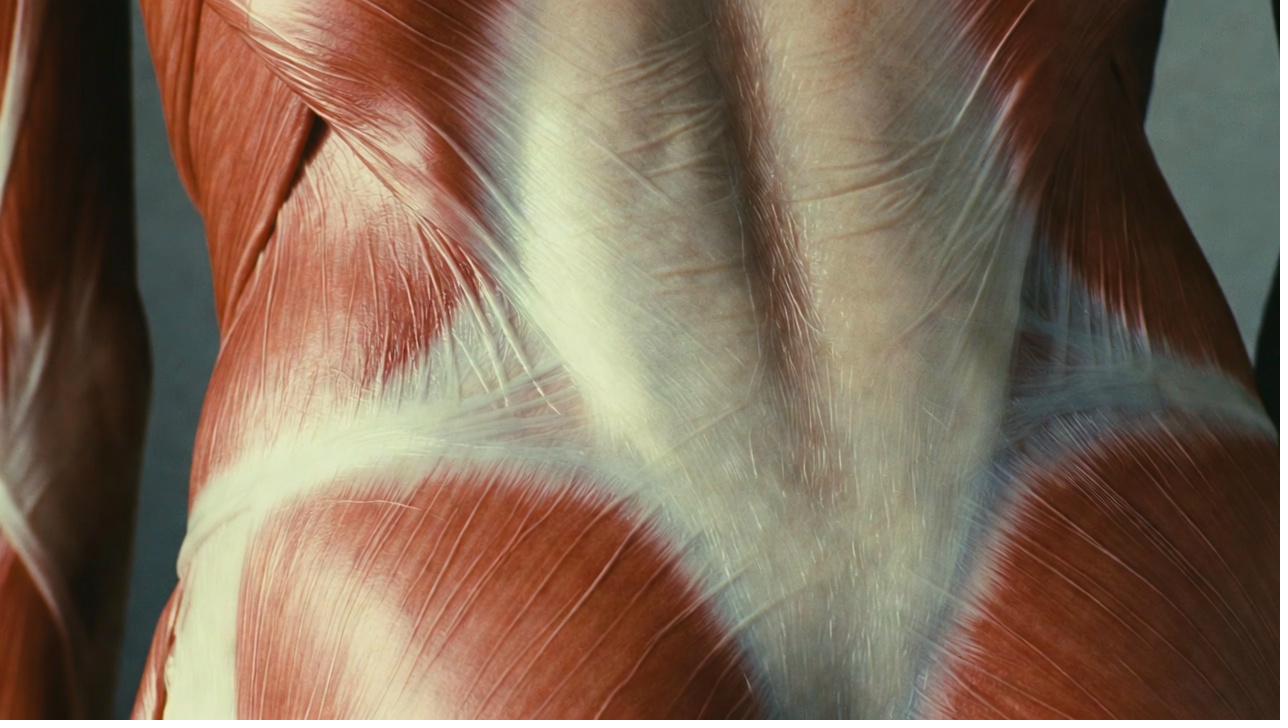
This dissection clip shows what Fascial restriction looks like at the site of pain. For anyone whose back pain has been described as muscular, structural, degenerative, or unexplained, this is the tissue that most back pain treatment does not assess. When this restriction is identified and addressed directly, the back pain changes in a way that local treatment alone has not been able to achieve.
Anatomy Trains dissection series, showing Fascial restriction at the site of pain
Understanding what is actually happening in the tissue makes the limitations of conventional back pain treatment clear. It also makes the results of Fascial treatment, when done properly, completely logical rather than surprising.
Who the Physology Approach is Best For
The patients who consistently see the most measurable results at Physology are those who have already tried the conventional back pain pathway. If you have had physiotherapy, chiropractic, osteopathy, pain management, or surgery, and your back pain has not resolved fully or has returned, the Fascial assessment at Physology is specifically designed to find what has been missed.
We also work effectively with patients who are at an earlier stage of their back pain journey but have already sensed that the approach they are being offered does not go deep enough. Patients who feel their back pain has a history or a source that nobody has been able to explain properly. Patients who have had a scan showing nothing measurable and been left without a clear answer. And patients who have been told they will need to manage their back pain long-term and are not prepared to accept that as the conclusion.
The Physology approach consistently produces different results for chronic back pain in Bath because we assess the Fascial system that most practitioners do not. For the majority of chronic back pain cases, that is the assessment that has been missing.
Back Pain Treatment in Bath and Bristol
Physology is located at WellBath Yoga and Wellbeing Centre, Woolley Lane, Bath BA1 8BA, with good access from central Bath and direct transport links from Bristol. We see back pain patients from across Bath and North East Somerset, Bristol, Keynsham, Midsomer Norton, Radstock, Frome, Wells, Shepton Mallet, Trowbridge, Chippenham, and the wider South West who are specifically looking for a practitioner who will assess the whole system rather than the local problem.
If you have searched for best treatment for back pain Bath, back pain specialist Bath, chronic back pain treatment Bath, or back pain clinic near me, you are likely in the group of patients who have already been through the conventional pathway and are looking for something more thorough. Our assessment process is designed precisely for that situation.
Call us on 01225 234954 or send a WhatsApp message before booking. Share your symptoms and a brief history and we will tell you exactly how the Physology approach can help you and what the assessment will involve.
What Patients Say
★★★★★
"James was very skillful, he was able to get me out of pain quickly even after only a few minutes of the initial treatment."
Verna Winarni — Chronic lower back pain from a QL/psoas injury
Pain relief within minutes of the first treatment
★★★★★
"Over 10 years I spent an awful lot of time and money visiting osteopaths and an NHS physio. In my experience, the treatment that James offers is life changing and I sincerely recommend it."
Auli Miles — Chronic back pain and sciatica, once facing surgery
Pain free. Has been ever since
★★★★★
"He was a breath of fresh air in terms of how he assessed and treated the injury. I went from hardly being able to walk to playing football again within about 2 months, rather than having to go under the knife."
Chris Quinlan — Back injury from football, avoided NHS surgery
Resolved after one session
If what you have read describes your experience, a conversation costs nothing.
You have almost certainly had an assessment before, from a physio, an osteopath, or a GP working from a scan. The two-hour Physology consultation is not a repeat of that process with different hands. It starts from a whole-body Fascial map rather than the site of pain, which is the main reason it tends to find what previous appointments missed.
1
A History Taken In Full, Not In Ten Minutes
Most previous appointments take a short history focused on the current flare. We take the complete version: every treatment tried, what helped temporarily and what did not, and the details that get skipped when an appointment is only fifteen minutes long.
2
Assessing the System, Not the Site
This is the step most previous treatment skips. Using the Anatomy Trains framework, we assess the pelvis, Diaphragm, posterior chain, and hip flexors alongside the lower back itself, because Fascial restriction rarely stays where it started and rarely shows up on a scan.
3
Why Previous Treatment Plateaued
By the end of the assessment you will understand specifically why physio, osteopathy, or a normal scan result did not resolve your back pain, and where the restriction actually sits that those approaches were not built to find.
4
Proof, Not Promises, in Session One
Treatment starts the same day. Most patients feel a 30 to 50 percent reduction in pain before they leave, which is the clearest way to judge whether this assessment has found something the others did not.
5
A Plan You Can Compare
You leave with a specific treatment plan and timeline, typically four to eight sessions to resolution, so you can weigh it directly against whatever you have already tried.
Common Questions
All three approaches have genuine value and all three primarily address the back and the structures immediately around it. If the driver of your back pain is a Fascial restriction chain that originated elsewhere in the system, treating the back cannot resolve it. The chain that is maintaining the pain has not been identified or addressed, which is why the same pain returns regardless of which local approach is applied.
Using the Anatomy Trains framework, we assess the whole Fascial system looking for primary restrictions and the compensation chains built around them. In most chronic back pain cases, the source is in the pelvis, the diaphragm, the posterior chain, or the deep hip flexors. The assessment maps the full chain and identifies the origin before any treatment begins.
Get in touch, tell us your symptoms and history, and we will tell you whether we can help and what treatment is likely to involve. Every presentation is different and we prefer to give you a clear, specific answer rather than a generic price list.
Because the approach is results-based, you will not need to guess. The change in session one is clear and measurable, and each subsequent session produces further improvement you can feel. Most patients are between 4 and 8 sessions in total. You will always know the treatment is working because you will feel the difference each time.
The first session is two hours. We begin with your full history, listening to everything about your pain, your previous treatment, and how it affects your life. We then carry out a complete whole-body Fascial assessment using the Anatomy Trains framework, explaining everything we find as we go. Treatment begins in the first session, and most patients leave with a measurable reduction in pain and a clear understanding of what has been driving their symptoms.
Physiotherapy assesses and treats the muscles and joints at the site of pain. It is skilled work and truly helps many presentations. What it does not assess is the Fascial system connecting those muscles and joints to the rest of the body. When chronic pain is driven by a Fascial restriction chain that originated elsewhere in the system, local physiotherapy cannot reach the source. That is the gap Physology is designed to close.
Message us on WhatsApp with a brief description of your symptoms and how long you have been dealing with them. James responds to every message personally, usually the same day. He will tell you whether your presentation matches what we treat and exactly what the first session will involve before you commit to anything. There is no obligation and no pressure. Send a message here.
Perspective
The Real Cost Is Everything You Have Already Spent
£10k+Typical specialist spend over 10 or more years of chronic pain
£2k+/yrOngoing medication and pain management costs
YearsLived in pain, doubt, and reduced quality of life
4 to 8Sessions to pain free with the Physology Method
Charlotte spent tens of thousands over 28 years before one session changed everything. The consultation is your chance to find out whether Fascia is the missing piece, with measurable proof on the day.
✓
The Physology Guarantee
If you do not feel a measurable reduction in pain in your first session, the consultation is free. No awkward conversations, no conditions. We are confident enough in what we do to put that in writing.
Physology Bath & Bristol
Ready for an Answer That Actually Explains Your Back Pain?
A Physology back pain consultation in Bath gives you a complete Fascial assessment, a clear map of what is driving your pain, and measurable improvement from the very first session. Serving Bath, Bristol, and the wider South West.
"James was very skillful, he was able to get me out of pain quickly even after only a few minutes of the initial treatment."
Verna Winarni — Chronic lower back pain from a QL/psoas injury
Pain relief within minutes of the first treatment
P.S. If you have tried everything for your back and nothing has lasted, the most likely explanation is that every treatment has been aimed at the back, and the source of the problem is not in the back. Get in touch and tell us the full history. We will tell you whether what you are describing fits what we consistently resolve.
P.P.S. Our Chronic Back Pain Guide is a free five-part resource covering exactly why chronic back pain persists and what the Fascial approach changes. What Is Fascia? and The Physology Method give you the complete picture before your first session.