The Hidden System Nobody Showed You
There is a tissue system in your body that most people have never heard of, yet it covers every single structure inside you.
It wraps every muscle. It envelops every nerve. It suspends every organ. It connects the sole of your foot to the top of your skull in one continuous, unbroken web. It contains more pain-sensitive nerve endings than the muscles it surrounds.
And it is almost certainly where your pain is coming from.
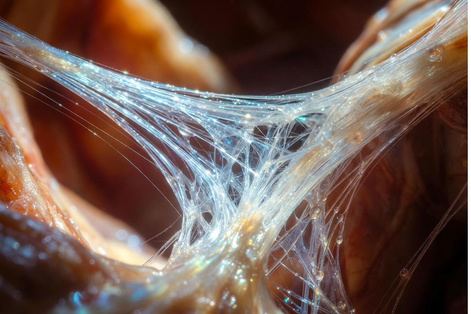
Before reading further, watch this short explainer on what Fascia actually is. Two minutes here will give everything that follows a different weight.

Fascia is a network of connective tissue that exists throughout the body as a single, continuous structure. It is made primarily of collagen and elastin fibres embedded in a gel-like matrix called ground substance.
When Fascia is healthy, it is hydrated, pliable, and slides freely over adjacent structures. When it becomes restricted, through injury, inflammation, poor posture, repetitive stress, dehydration, or the accumulated compensations of chronic pain, it loses hydration, becomes denser, and starts generating signals that the nervous system interprets as pain.
The crucial thing to understand is that Fascia communicates across the entire body. A restriction in your hip can generate pain in your shoulder. A restriction in your neck can produce symptoms in your lower back. The site of pain and the source of the problem are very often in different places entirely.

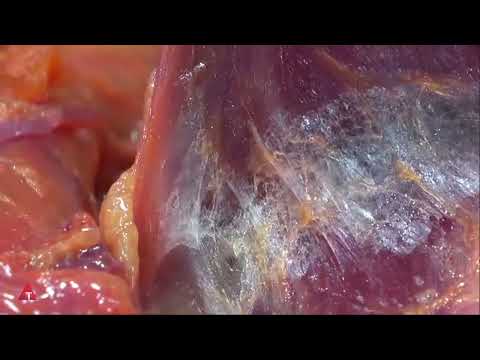
This next video shows Fascia filmed inside a living body. It makes the difference between healthy and restricted tissue visible in a way no description can fully achieve.
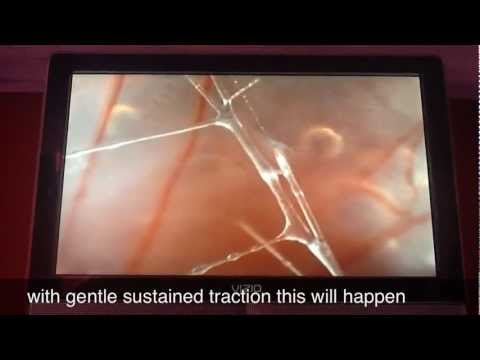
The pain is where the tension is landing. The restriction is where it is coming from. This single insight explains why treating the site of pain so rarely produces lasting results. You are treating the symptom. The cause is elsewhere in the system.
You know your own body. You have always known. The fact that a machine could not see what you can feel does not mean you were wrong. It means the machine was not looking for the right thing.
Fascial restrictions do not show up on MRI. They are invisible to X-ray. CT scans cannot detect them. Ultrasound can sometimes show thickening in specific areas, but gives no picture of the system-wide restriction pattern that is generating your pain.
The tools were designed to detect different things. Standard imaging was developed to identify bone, disc, and gross tissue changes. It was never designed to detect the viscosity changes, densification, and restriction patterns that drive fascial pain.
You had normal imaging not because there was nothing wrong. But because what was wrong could not be seen by the tools being used.
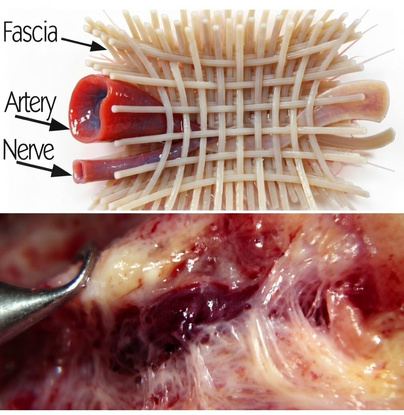
This video shows exactly what happens when fascial tissue is under tension. Watch how a restriction in one area pulls through the connected system to create symptoms somewhere else entirely.

Your Fascial network is one continuous structure.
Your shoulder is not anatomically separate from your hip. Your neck connects, through continuous Fascial tissue, to your chest, your diaphragm, your abdomen, your hip flexors, and your legs. This is anatomy.
The practical consequence is this: a restriction in one area of your Fascial network creates tension throughout the network. And because Fascial lines run in specific directions, that tension lands in predictable places, often distant from the restriction itself.
This is why your left shoulder hurts when the restriction is in your right hip. This is why your neck aches when the problem is in your thoracic spine. This is why treating the painful area gives temporary relief but not resolution, because the pain location is where the tension is landing, not where it is coming from.
This insight changes everything about how you understand your pain. Your pain is not local. It is a symptom of a system-wide dysfunction. And understanding that means you understand why your pain has not resolved. Nobody has been treating the system. They have been treating the symptom.
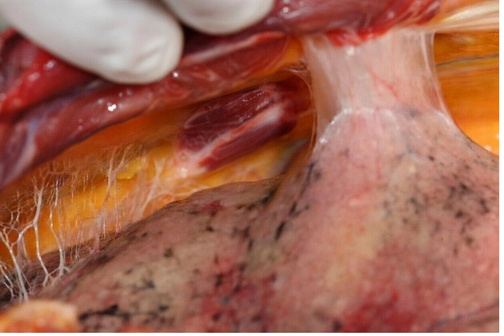
Within your Fascial network is a substance called ground substance, also sometimes referred to by its primary component, hyaluronic acid.
Ground substance is the gel-like matrix that fills the spaces between Fascial fibres. It is approximately 70% water. When it is well-hydrated and at the right viscosity, it allows Fascial layers to glide freely past each other, transmits force efficiently, and keeps the pain-sensing nerve endings in your Fascia from being mechanically irritated.
When it becomes pathologically dense, a condition researchers call Fascial densification, it loses its lubricating properties. It becomes sticky rather than slippery. It begins to glue Fascial layers together. The nerve endings embedded in that densified tissue are now subject to constant mechanical irritation, and they respond by generating pain signals.
The critical insight here is that this process is reversible.
Ground substance densification is not permanent. It is not a life sentence. The right kind of skilled, sustained manual work changes the viscosity of that ground substance. It essentially rehydrates and re-lubricates the Fascial tissue, and allows the layers to separate and slide again. This is not a temporary effect. It is a genuine physical change in the tissue.
This is why Fascial therapy can produce lasting results when everything else has been temporary.
A comprehensive review of hyaluronan biology confirmed that Fascial densification is a reversible process, with manual therapy shown to reduce ground substance viscosity and restore normal tissue gliding. Read the research
Research confirmed that hyaluronan aggregation occurs across multiple human organs and that targeted manual work can restore the normal physiological state of the tissue. Read the research
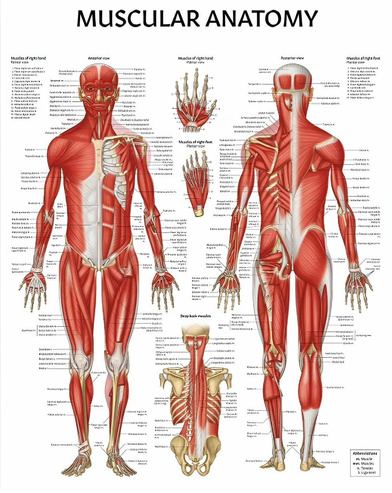
For centuries, anatomists studied the body by cutting it apart. They would remove a muscle, trace its attachments, name it, and move on. The result was the muscle charts you will have seen on the wall of every physio clinic and GP surgery you have ever visited. Individual muscles, drawn in isolation, each with a clearly defined origin and insertion, each responsible for a specific movement.
Those charts are incomplete in ways that matter. And that incompleteness has been directing your treatment toward the wrong approach for as long as you have been in pain.
In the 1990s, a researcher and bodyworker named Thomas Myers began doing something different with cadaveric dissections. Rather than removing individual muscles and discarding the fascial tissue around them, he preserved the Fascia. He kept the whole system intact and traced where the connective tissue actually ran.
What he found changed the map of the human body.
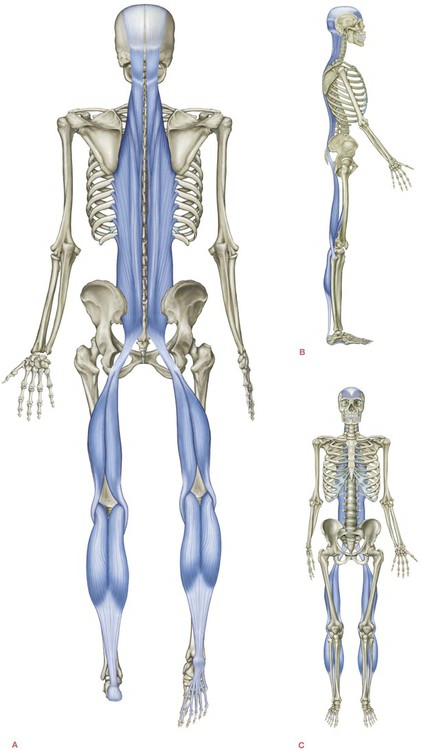
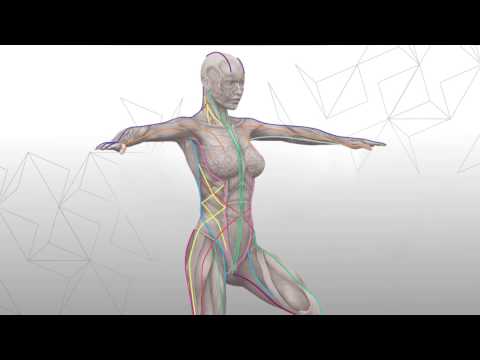
The Fascia does not stop at the edge of a muscle. It continues. It runs through the tendon, across the joint, into the next structure, and on through the body in long unbroken lines from one end to the other. Myers documented these lines, twelve in total, and called them the Anatomy Trains.
The Superficial Back Line runs continuously from the soles of your feet, up through your calves, your hamstrings, your lower back, over your skull, and down to your eyebrows. It is not a collection of separate muscles. In fascial terms, it is one structure. Pull anywhere on that line and you create tension throughout it.
The Deep Front Line runs through the inner arch of your foot, up through your inner leg, through the psoas deep in your abdomen, your diaphragm, your ribcage, and into your throat. It is the deepest structural line in the body and the one most commonly involved in fibromyalgia and chronic widespread pain.
The old muscle chart shows your hamstrings as a structure that ends at your pelvis. The Anatomy Trains map shows a continuous fascial line running from your heel to your skull. These are not two descriptions of the same thing. They are two fundamentally different understandings of how the body is actually organised.
The Anatomy Trains myofascial meridians, the same body shown from multiple angles, each view revealing a different continuous fascial line. This is the map that skilled practitioners work from. A practitioner still using the traditional muscle chart is working from a framework that predates this research by decades.
The practical consequence of this is enormous. If you treat your hamstring as an isolated structure, you might stretch it, strengthen it, or inject it. You get temporary relief at best. But if you understand it as part of a continuous line running the full length of your body, you immediately understand why a restriction at your heel can generate pain in your lower back, why a restriction in your calves can cause headaches, and why your body responds better to whole-system treatment than to anything local.
This is what makes treating only the site of pain anatomically prehistoric, and ineffective for the same reason. The old charts sent every practitioner you have seen to the location of your pain, because that is where the structure they were trained to treat appeared to be. The Anatomy Trains maps make clear that the structure runs through your entire body. There is no logical reason to treat locally. There never was.
When you look at an Anatomy Trains map, the approach of treating the site of pain stops making sense. You cannot look at a continuous fascial line running from heel to skull and conclude that the sensible thing to do is treat one small section of it in isolation. The images tell you what the research confirms and what twenty years of clinical experience demonstrates. You have to treat the system.
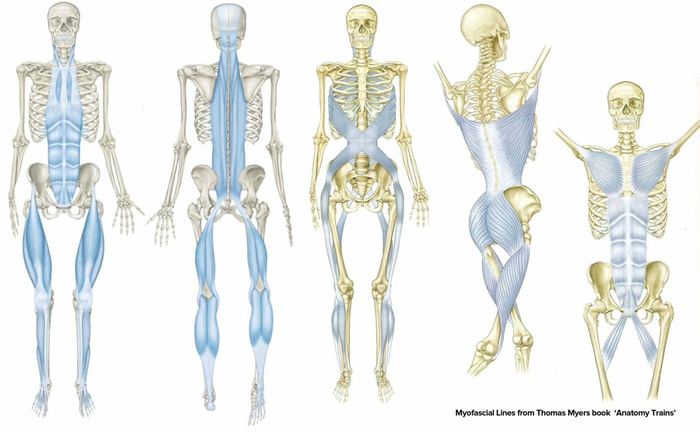
The foundational text documenting fascial continuity through cadaveric dissection, establishing the twelve myofascial meridians and demonstrating that force transmission occurs through continuous fascial lines rather than isolated muscle units. Read the research
A systematic review of the evidence for myofascial chains confirmed that mechanical force is transmitted along fascial lines across multiple body segments, validating the anatomical basis of the Anatomy Trains model. Read the research
The tissue system that connects everything is the same one your pain has been travelling through. Understanding it changes what is possible.
Being told everything is normal when nothing about your life feels normal is a particular kind of loneliness that only people in chronic pain understand.