The Nervous System: Why Pain Persists
Central sensitisation is real. What conventional medicine missed is why it happens.
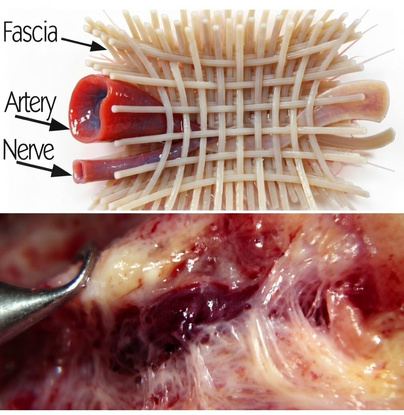
Your nervous system does not float freely inside your body. It does not travel through empty space between your organs. Every nerve in your body, from the largest to the smallest, runs through Fascia. It is surrounded by it, supported by it, and in healthy tissue, protected by it.
This matters enormously for understanding why your pain has persisted.
When Fascia becomes restricted, it does not just restrict movement. It physically grips the nerves running through it. It applies sustained mechanical pressure to tissue that is densely packed with sensitised receptors. The nerve does not need to be trapped by a disc or damaged by an injury. It simply needs to be held in compressed, restricted tissue for a prolonged period of time. That is enough. That is more than enough.
When a nerve is subjected to sustained compression or mechanical irritation, its sensitivity changes. The threshold at which it fires pain signals drops. It begins responding to stimuli that would not previously have produced pain. Over time, this heightened reactivity becomes the nervous system's new baseline.
This is called central sensitisation, and it is well established in the research. The medical world has known for decades that it happens. The brain and spinal cord's pain processing architecture physically reorganises itself under sustained signal load, becoming more reactive, more alert, more ready to generate pain in response to incoming information.
Central sensitisation explains why a light touch becomes painful. Why cold air triggers a response. Why you can be in significant pain with no identifiable injury on a scan. The nervous system is not malfunctioning. It has adapted, accurately and sensibly, to the signals it has been receiving.
What conventional medicine has struggled to explain is why it starts. The labels are available. The description of what is happening is detailed and well-researched. But the question of what is generating the sustained signal load in the first place has remained frustratingly vague. Doctors will sometimes attribute it to an old injury that "set things off." Sometimes to damage that cannot be seen on current imaging. Sometimes to the possibility that a nerve is compressed somewhere in the spine.
The answer, in the overwhelming majority of chronic pain cases, has been sitting in the tissue the whole time. The Fascia surrounding those nerves has been restricting them. The signal load driving central sensitisation has been coming from within the fascial system. And because nobody was assessing the Fascia, nobody found it.
A systematic review confirmed that Fascia is richly innervated and that fascial nociceptors, when activated by restriction or densification, generate sustained afferent input to the central nervous system, providing a direct mechanical explanation for central sensitisation in chronic musculoskeletal pain. Read the research
A light touch should not be painful. Cold air should not make you wince. When your whole body feels like an exposed nerve, that is not you being dramatic. That is your nervous system doing exactly what it was designed to do with the signals it has been receiving for years.
When a patient presents with widespread pain and heightened sensitivity, and the scans show nothing, conventional medicine reaches for the central sensitisation framework. The nervous system has become overreactive. The treatment is therefore aimed at the nervous system: pain medication, nerve pain drugs, sometimes antidepressants for their effect on pain modulation, and cognitive approaches that aim to retrain the brain's response to signals.
None of this is wrong. Some of it provides genuine relief. But it is addressing the response without addressing what is driving the response. The Fascia gripping those nerves is still there. The mechanical irritation is still ongoing. The moment the medication wears off, or the moment treatment stops, the nervous system returns to the state the tissue has been pushing it toward.
This is why the relief never fully lasts. Not because the treatment failed. Because the source was never reached.
The spine explanation follows a similar pattern. When pain radiates, or when nerve-like symptoms appear in an arm or leg, conventional medicine looks for a compressed disc or a narrowed foramen. Sometimes this is exactly what is happening, and surgery or injection resolves it. But in many cases, the investigation finds nothing significant, or finds something minor that should not be producing the symptoms described. The patient is sent away with the explanation that the pain is likely referred from somewhere, or that a nerve is mildly irritated, or that there may have been some historical compression that sensitised things.
All of that can be true. But in most cases, the fascial tissue along the path of that nerve, through the hip, through the posterior chain, through the shoulder girdle, has been mechanically compressing it the whole time. Not at the spine. In the tissue.
Strip away the terminology and the complexity, and the picture is simple.
Your nervous system lives inside your Fascia. When your Fascia becomes restricted, it grips your nerves. Gripped nerves generate sustained pain signals. Sustained pain signals cause your central nervous system to reorganise around chronic threat. The result is widespread, seemingly inexplicable pain that no scan can locate and no standard treatment can resolve, because the standard treatments are not looking at the tissue that is causing it.
Why Pain Persists: The Mechanical Source
Fascial Restriction
Tissue grips the nerve
Nerve Compression
Sustained mechanical load
Pain Signals
Constant afferent load to CNS
Sensitisation
Lower threshold, more pain
The Fascia grips the nerve. The nerve generates signals. The brain reorganises around threat. Address the Fascia, the rest follows.
That assessment is what changes everything. Because once you locate the restrictions that are driving the sensitisation, the treatment becomes logical, targeted, and effective. The nervous system does not stay sensitised when the sustained mechanical input stops. It recalibrates. The sensitivity drops. The pain reduces. The body returns to baseline.
The condition that seemed like a permanent, complicated, poorly-understood disorder turns out to have a mechanical explanation that has been present in the tissue the entire time.
That is not a small thing. That is the difference between managing pain and resolving it.
People tell you to relax. As if relaxing is a choice you are making badly. Your nervous system is locked in a state of defence that you cannot think your way out of. It is not a mindset problem. It is a physical one.